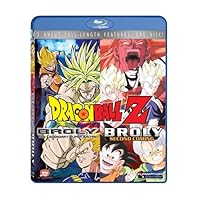
 This Blu-Ray is actually a double-feature, containing the first two movies of the popular anime series DRAGON BALL Z that involve Broly (there is a third one not featured in this Blu-Ray).
This release is unprecedented in the history of anime as it is one of the first anime titles to be released in a high-definition format, in this case Blu-Ray. As such, you're going to get the best out of this purchase if you own both a Blu-Ray player (such as the Playstation 3) as well as a high-definition TV.
This release is also part of FUNimation's continued effort to put DRAGON BALL Z through a remastering process. This process, which was undertaken by using the original Japanese film negatives, involves removal of old scratches and grain, restoration of the original colors, and a crisp, clear digital restoration of the voices and sound effects for 5.1 surround sound (although 2.0 stereo is available for those without surround sound). The result is an absolutely beautiful 1080p picture and some wonderful sound that quickly warrant a 5/5 review from me.
Having said that, you undoubtedly have read complaints involving the remastering process (which infuriatingly insist on putting the word "remaster" in quotation marks, as if to indicate that the process was a careless, reckless, and effortless attempt). The most frequent of these complaints is the complaint of the original aspect ratio of the picture. Approximately 20% of the original 4:3 picture (consisting of both the top and bottom portions combined) was eliminated in order to produce the 16:9 widescreen format that this Blu-Ray plays the film in. As a compensation, 10% of the footage that appears on the left and right side, normally absent from 4:3 presentations, appears here. However, many fans have still taken issue with this, arguing that since the picture was originally presented in 4:3, it should also be presented in 4:3 on the Blu-Ray. This argument deserves some consideration when referring to the remastered DVD season box sets of DRAGON BALL Z by FUNimation (the first parts of the DRAGON BALL Z franchise to be remastered), which were originally presented in 4:3 and, prior to FUNimations' remastering, were never presented in 16:9.
However, the movies are a different story. They actually were originally presented in 16:9, as their first release was in Japanese movie theaters. As such, 16:9 actually *is* the original aspect ratio for the movies, just not for the TV episodes. Just like here, 20% of the vertical image was eliminated. The difference here, though, is that unlike the TV season box sets which also eliminated 20% of the vertical image, the original animators of the DRAGON BALL Z movies knew ahead of time that the movies were going to be presented in 16:9 (because it was in movie theaters), and kept this in mind while animating so that no details of any importance would be lost.
In reality, the only time the movies have seen a 4:3 release are in the first English DVD copies released by FUNimation (these movies have been released before, but without the remastering process). As such, Japan has never seen any kind of release, DVD or otherwise, of the movies in 4:3. So to say that this release is not the original aspect ratio is completley incorrect.
Having said that, I'm not completley satisfied with this release for two reasons. Firstly, the remastering process for the TV season box sets has included an option that allows for the english voices to be heard alongside the original Japanese music in 5.1 surround sound. No such option exists here. The only options are to hear the dub music/English voice combo in either 5.1 surround sound or 2.0 stereo. Considering the storage space offered on Blu-Ray, this is rather baffling.
The second major complaint is that, while the original Japanese voice/Japanese music combo are available (with expertly-translated subtitles by Steve Simmons), they are only available in 1.0 Mono. This is understandable for the DVD releases due to the limited storage space, but Blu-Ray has a whopping 50 GB of storage. There's absolutely no excuse for not remastering the Japanese voices.
Otherwise, though, this release is absolutely incredible. The visual quality of the picture thanks to the remastering process is absolutely incredible, having restored the animation to its original pristine condition, if not better. The acting is also very well-done from both the Japanese and the English voice cast, and many DRAGON BALL Z fans have noted that the English script for this movie, as written by Christopher R. Sabat (the voice of Vegeta and Piccolo) is the most faithful translation FUNimation has ever given a DRAGON BALL Z release. The dub music, while not as good as the original Japanese music, still manages to be lively enough in its own right.
I would absolutely recommend this purchase, it's worth every dollar and then some.
PS: UPDATE (7/24/2012)...
So..you know how I said that FUNimation had "no excuse for not remastering the Japanese voices"? Well...turns out...I was wrong. They do have an excuse. A perfectly acceptable one, for that matter.
The reason the audio quality of the English dub audio is so much better than the audio quality of the original Japanese audio is for two reasons:
1) The English dub was recorded with slightly better audio equipment.
2) The original masters for the Japanese audio were, in the case of the TV series, destroyed by Toei. In the case of the movies, the original masters were not destroyed, but they were not what was given to to FUNimation for dubbing purposes.
The first point is self-explanatory, so I'll go into detail about the second point a little bit.
Back in the day DBZ was recorded, everything was still done on film reels. Big, big film reels that took up space in warehouses. However, even with the first DB episode, the audio was recorded and mixed in very high-quality mono, and those film reels were then sent off to Fuji TV (the network that originally aired the show in Japan) for them to air. If you search YouTube for "Dragon Ball Fuji TV" or "Dragon Ball Z Fuji TV," you might be able to find uploaded examples of these episodes from people who taped them when they originally aired. The thing is, that high-quality audio on the film reels was only aired on Fuji TV once. After that, the film reels were converted to significantly lower-quality video tapes (which is what Fuji TV would use for reruns), and the original film reels were destroyed to make room for more film in Toei's warehouses.
This usually leads people to ask, "WHY IN GOD'S NAME WOULD THEY DESTROY THE BEST AVAILABLE MATERIALS FOR THEIR TV SHOW!?" The answer to that is because the marketplace back then is much different than it is now. Back in the late 80's and mid 90's, we didn't have DVD. We just had VHS, and it was considered absurd that someone would buy hundreds of VHS tapes to own the entirety of a TV series. Plainly put, there wasn't a market for home releases of TV shows back then. So, since Toei figured the only way people were ever going to see the show again was through TV reruns, they figured that replaying the lower-quality tapes that the film reels were converted to would suffice.
So, in the case of DB and DBZ, the original film reels were destroyed. Which sucks, because in order to remaster anything into a higher audio quality, you need the source material. FUNimation can do that with their English dub audio because, since they still have the original source recordings for their dub, they can--and did--upgrade it easily. Toei, however, destroyed their original film reel mono masters, so upgrading the audio or, for that matter, even replicating the original audio, is now no longer possible.
Even the "Dragon Boxes" which have since been released, and many fans of the original Japanese version hold up to be the pinnacle example of how to release a series on home video, is considered a little bit of a rip-off by those in the know. The audio quality for the Japanese audio on the Dragon Boxes, while probably the best remaining audio we have available, is not NEARLY what it was when the show originally aired on Fuji TV, and while the visuals were remastered, the film they used had aged a bit, distorting the colors somewhat. For that reason, there will unfortunately never be a "perfect" release of DB, DBZ, or their movies. The materials needed to do that simply no longer exist.
...However, small exceptions do exist. Toei DID keep the film reels for the *movies.* The Dragon Box release of the movies used that as their audio source, and if you ever get a chance to watch the movies on the Dragon Box release, you will notice that the Japanese audio, while still mixed in mono, is significantly higher quality than what's on the TV shows. Furthermore, for some odd reason, Fuji TV did keep the original audio sources for Dragon Ball GT. For yet another odd reason, Toei decided not to use that as their source of audio for the Dragon Box release of GT (perhaps because while they have the rights to GT, they don't have the rights to those specific tapes as they are the property of Fuji TV?).
Finally, the reason the FUNimation releases of the Japanese audio on the movies, and on GT, doesn't sound as good as good is because Toei didn't provide FUNimation with those audio sources. They didn't provide any of the international dubbing studios with those sources. They were notorious back in the day for delivering pretty lousy masters to their international licensees. They did deliver pretty high quality ME tapes ("Music and Effects only" tapes) to FUNimation, because Toei held on to the original MEs to distribute to their international licensees for dubbing purposes.
Alas, we're never going to get a "perfect" release of anything related to DB, DBZ, or DBGT. However, that would be because Toei destroyed the original materials. It ain't FUNimation's fault, and I shouldn't have blamed them for that in my review.

All in all, if you are a fan, definitely get this addition, otherwise newcomers, I would not spend on this. (unless you are curious that is.)
* Reviewed with this setup *
Sony Bravia 40V2500 1080p LCD
Sony Playstation 3
Buy Dragon Ball Z - Broly Double Feature (2007) Now
Dragon Ball Z Blu-Ray looks amazing. I was amazed to see how great the video quality can be in high definition. I was disappointed that there wasn't any PCM lossless audio but I still enjoyed it. To anyone who has seen DBZ and still likes it or just want to see how DBZ would look like in high definition I recommend buying this Blu-Ray disc to see how amazing DBZ can really be.Read Best Reviews of Dragon Ball Z - Broly Double Feature (2007) Here
In November 2007, FUNimation Entertainment had their first release using Hi-Definition Blu-ray technology with the release of their two of the most succesful "DRAGON BALL Z" films "Broly The Legendary Super Saiyan" (the eighth "DRAGON BALL Z" film released on March 1993) and "Broly The Second Coming" (the tenth "DRAGON BALL Z" film released on March 1994).As a "DRAGON BALL Z" fan, the Broly films have always been my favorites, especially "Broly The Second Coming" which I first saw (in Japanese) at an anime club meeting back in 1994.
But whenever there is a film with Broly, you can expect a lot of action and intense battles. And personally, the "DRAGON BALL Z" films that involve "Broly" plot-wise are the best!
VIDEO AND AUDIO:
"DRAGON BALL Z" is featured in High Definition Widescreen at 1920 x 1080P. According to a flyer inside the case, there is information about the transfer and how the original Japanese film masters were transferred via an industry-standard Spirit DataCine, passing through a Digital Vision DVNR10000 to remove film grain and another round of processing using a Teranex VCooo video computer. These digital noise-reduction units helped to remove thousands of instances of dirt, scratches and debris.
The cleaned footage signal went through a da Vinci 2K Plus color system to ensure that the colors were true to the original film prints. The final media for transfer was Sony's HDCAM, a high-definition digital tape.
With that being said, let me first say that a lot of older Japanese animated films have not been taken care of. In fact, many anime films have had warping and major issues that restoration even to DVD has not been all that great. Unless, there was an expensive facility developed for it (such as the recent "AKIRA" release which was an expensive remastering process), there's only so much that can be done to make an older Japanese film look great.
With that being said, there is a big difference between the video quality of "Broly The Legendary Super Saiyan" which has looked like the previous "DRAGON BALL Z" films that were released on Blu-ray and "Broly The Second Coming". With "Broly The Second Coming", one thing you'll notice is a slight art difference with the background art and also the colors are much more vibrant and colorful.
One can say that the later the film is, the better the colors and I suppose that you can say in this case, the tenth film is much, much cleaner and colorful than the eighth.
But with that being said, "Broly the Legendary Super Saiyan" does look good for an anime film that is 16-years-old and "Broly Second Coming" which is 15-years-old which colors and animation is so far the best in video quality compared to the other "DRAGON BALL Z" films and specials preceding it.
Now one of the things that has been an issue with older "DRAGON BALL Z" films is the scratches and dust. Despite the DNR units that helped to remove thousands of instances of difrt, scratches and debris, again... with a lot of the original Japanese film sources not really being taken care of, there is only so much that can be done. And in this case, there are visible scratches, dust and even some warping at times but nowhere as numerous as the first two "DRAGON BALL Z" films.
As for audio, audio is presented in English 5.1 Dolby Surround
Sound (HD-DTS), English Stereo and Original Japanese. Unlike the newer "DRAGON BALL Z" Blu-ray releases, there is typically an English 5.1 Dolby TrueHD audio track with the English with newer music and another with the Japanese music track. Because this is a 2007 Blu-ray release, the track I tend to listen to is the English track with the original Japanese music.
JUDGMENT CALL:
Having watched these film in original Japanese before, I watched it again in Japanese but when watching on Blu-ray, you want that awesome sound, so watching these two films with the Pantera and rock n' roll guitar and percussion driven music was definitely a first for me.
I have to admit that hearing the heavy metal like guitar churning and heavy hitting music, definitely added an enjoyable side to watching these two films and really gave the film some extra energy during the battle scenes.
And when it comes to the English dubbing, FUNimation Entertainment has one of the best well-casted series with "DRAGON BALL Z" films. In fact, it's actually difficult for me to watch the original Japanese (that I grew up watching for years) because of the significant vocals with the English dub track. So, the English dub track was well-acted and again, enjoyable!
SPECIAL FEATURES:
The "DRAGON BALL Z" films really don't come with anything for special features but surprising enough, there were two featurettes. One that featured the transfer and bringing "DRAGON BALL Z" to Blu-ray. From making the films as 16×9 and other technical but informative facts about the transfer. The other is mainly a promotional for the upcoming "DRAGON BALL Z" television series to DVD.
With many "DRAGON BALL Z" films being short and sweet, one of the exciting things about Broly is that he has made his appearance in three films (which includes the eleventh film "Bio-Broly"). It's important to note that at this time of my review, FUNimation Entertainment has planned on a triple feature "Broly" release in Spring 2009. So, suffice to say, this double-Broly release may be out of print.
Suffice to say, the Broly films are my favorite "DRAGON BALL Z" films. There is a good plot, intense action and overall, compared to the other films, the Broly films are just enjoyable!
"Broly The Legendary Super Saiyan" is the longest running "DRAGON BALL Z" film at 71 minutes. The second film "Broly The Second Coming" is about 60 minutes long.
I can't tell you how much I enjoyed watching these two films again, especially my personal favorite "Broly The Second Coming" on Blu-ray. The colors were just vibrant and after watching many of the films out on Blu-ray thus far, to see the clarity of the tenth film was just amazing.
Granted, the transfer is not perfect and there are signs of scratches, dust and a little film warping on very few frames but I was very impressed with the transfer to Blu-ray for both films considering how old the films are.
As mentioned, the "Broly" trilogy will be released on Blu-ray in Spring of 2009 and this "Broly" double feature may be out of print and no longer be available. This Blu-ray disc was the first release for FUNimation Entertainment back in 2007 but nevertheless, if you are able to find this release for a low price or have no interest in the eleventh film "Bio-Broly", then definitely pick this title up.
Overall, the "DRAGON BALL Z" Broly films are just fun to watch. I have to admit that I enjoyed listening to FUNimation's heavy metal, guitar and percussion driven music soundtrack during the battles, considering I'm more into the original Japanese dialogue and music. Being a hardcore "DRAGON BALL Z" fan, I was a bit skeptical at first of heavy rock bands being used for the musical soundtrack of the English dub but it definitely added a charged up, energetic feel to those action-packed moments. And there are many action-packed scenes on both features.
Overall, another solid "DRAGON BALL Z" release and these two films look good on Blu-ray. "DRAGON BALL Z" fans, this double-feature is definitely worth checking out!
Want Dragon Ball Z - Broly Double Feature (2007) Discount?
I love DBZ and the Broly movies are great. Picture looks amazing but it definitely shows its age. Widescreen is nice. Would have gave it five stars but the picture isn't consistant throughout.Save 39% Off

No comments:
Post a Comment