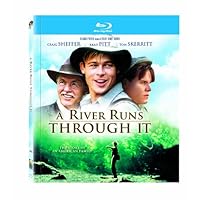
 This review refers to the Columbia/Tristar DVD edition of "A River Runs Through It"...
Even with Brad Pitt co-starring in this film, it was the awesome cinematography that kept me mesmerized. Filmed in the lush mountains and rivers of Montana, director Robert Redford and Director of Photography Phillipe Rousselot(who won an Oscar for his work on this film)capture the beauty of this land and the story.
Based on a autobiographical novella by Norman Maclean, we are swept back to the earlier part of the 20th century with the Maclean family. Family, church and Fly fishing came above all else. Norman, played at the younger age by newcomer Joseph Gordon-Levitt(who was honored with the Young Artists award in 1993 for his performance), and his younger brother Paul are close and come from a loving but highly disciplined household, run by their stern father(Tom Skerritt) the Reverend of the small town church. The Rev. is strict when it comes to their education, but a big part of that education is the freedom to fly-fish, enjoyed by all the Maclean men.
We watch as Norman and Paul grow into men(Craig Scheffer/Brad Pitt) and how differently their lives turn out. Norman grows into a fine scholar, but Paul takes a different path. His is one of a rebel, who finds trouble at every turn. But always they have their love for each other, their family, and their love of fly-fishing. Paul turns it into an art that is a sight to behold in that beautiful Montana scenery.
Other fine performances are turned in by Brenda Blethyn as Mrs. Maclean, Emily Lloyd as Jessie Burns, the girl Norman loses his heart to and Vann Gravage who plays the young Paul. A beautiful music score by Mark Isham adds greatly to the view without being obtrusive to the story. A fine screenplay by Richard Freidenberg will draw you in and keep you there. It's a great break from action movies without getting overly dramatic.
It is rated PG, but probably not appropiate for the younger viewers, there are some adult themes as well as brief nudity.
Columbia has done justice to this beautifully filmed movie in it's transfer to DVD. Just Gorgeous! Remastered in anamorphic widescreen(if you prefer full screen, that is on side B)with excellent clarity of the colors as well as the picture. The sound remastered in Dolby 2.0 Surround was very good, but I would have loved to hear it in 5.1. It may be viewed in French, Spanish(also stereo),or Portuguese(mono), and has subtitles in these languages as well as English. There are theatrical trailers and Talent files, but no other special features.
If your in the mood for a great action thriller, this is NOT it! This is a film to just sit back and savor.....Oh and I really did enjoy Brad Pitt's performance(almost as much as the scenery)...enjoy....Laurie
also recommended:
Meet Joe Black
The Color Purple
Studs Lonigan (1960)

Set in early 20th century rural Montana, this is the coming-of-age story of the author and his brother Paul, sons of a Scottish Presbyterian minister who raised them with both love and sternness and instilled in them, more than anything else, an understanding for the divine beauty of their land, symbolized by and culminating in a fly fisherman's skill in casting his rod, and his ability to become one with the river in which he fishes. For, in Norman Maclean's words, in their family "there was no clear line between religion and fly fishing;" and growing up, the brothers came to believe quite naturally that Jesus's disciples themselves must have been fly fishermen, too; and that consequently every good fly fisherman is closer to the divine than any other human.
But while they were united by their love for their native land and its rivers and fish, the brothers couldn't have been any more different on a personal level. And thus, this is also a story of brotherly (and parental) love and loss, of the inability to communicate, and of dreams and aspirations nurtured and fatally disappointed. While disciplined, sensible Norman (Craig Sheffer) left Montana for a six-year college education at Dartmouth and ultimately after having temporarily returned home and taken a bride to assume a teaching position at the University of Chicago, rebellious Paul (Brad Pitt in a truly career-defining role) knew that he would never leave his home state and "the fish he had not yet caught;" and opted for a journalist's life instead. But ultimately he wasn't able to fight the demons that possessed him; and his parents and brother had to stand by and helplessly watch him embark on a path of self-destruction, reduced to comments on symbolic matters like Paul's decision to change the spelling of their last name by capitalizing the "L" ("Now everybody will think we are Lowland Scots," scorned their father), where to open topicalize their concerns would have destroyed the careful equilibrium of mutual respect, love, hope, caution and guardedness characterizing their relationship. And so, only after Paul's death could his father tell a hesitant Norman that he knew more about his brother than the fact that Paul had been a fine fisherman: "He was beautiful" and mourn in a sermon, even later, that all too frequently, when looking at a loved one in need, "either we don't know what part of ourselves to give or, more often than not, the part we have to give is not wanted. And so it is those we live with and should know who elude us. But we can still love them. We can love completely, without complete understanding."
Craig Sheffer and Brad Pitt are perfectly cast as the earnest, reasonable Norman and his maverick brother Paul, who relies on his innate toughness in his fateful attempt to take life to its limits and still beat the devil, but who also turns the casting of a fishing line into an art form that makes a rainbow rise from the water, and who with his greatest-ever catch stands before his father and brother "suspended above the earth, free from all its laws, like a work of art." Moreover, this movie reunited Robert Redford with Tom Skerritt, with whom he had first shared the screen in the 1962 Korean war drama "War Hunt" (both actors' big-screen debut), and who gives a finely-tuned, sensitive performance as the Reverend Maclean. Notable are also the appearances of Brenda Blethyn as Mrs. Maclean and Emily Lloyd as Norman's bride-to-be Jessie. But the movie's true star is Montana itself, particularly its rivers and streams; every frame of Philippe Rousselot's Academy Award-winning cinematography and every sweep of the camera over Montana's magnificent landscape, and along the silver bands of its rivers with their gurgling cataracts and waves curling softly against their banks, powerful testimony to Robert Redford's genuine love and respect for the West and for nature in general; the causes closest to his heart and matched in importance only by his efforts to promote a movie scene outside of Hollywood. And Redford himself assumes the (uncredited) role of the narrator, thus bringing to the screen Norman Maclean's lyrical language and uniting words and pictures in an audiovisual sonnet, subtly accentuated by Mark Isham's gentle score.
Both movie and novella end with the lines that have given the story its title: "[I]n the half-light of the canyon, all existence fades to a being with my soul; and memories, and the sounds of the Big Blackfoot River, and a four-count rhythm, and the hope that a fish will rise. Eventually, all things merge into one; and a river runs through it. The river was cut by the world's great flood and runs over rocks from the basement of time. On some of the rocks are timeless raindrops. Under the rocks are the words, and some of the words are theirs" those of Norman Maclean's now-lost loved ones; those he "loved and did not understand in [his] youth." As we have had to learn, it is not only human life that is terminal; even nature itself (including, incidentally, the Macleans' beloved Big Blackfoot River) is not immune to destruction by human carelessness. This movie is a powerful plea to all of us not to wait until it has become too late.
Also recommended:
A River Runs through It and Other Stories, Twenty-fifth Anniversary Edition
The Norman Maclean Reader
Norman MacLean (Western Writers)
The Big Sky
Desert Solitaire
Jeremiah Johnson
The Horse Whisperer
Legends of the Fall (Deluxe Edition)
Spy Game (Widescreen Edition)
Buy A River Runs Through It (1992) Now
A River Runs Through It is one of those films that can be watched over and over. The movie focases on the lives of two brothers(Brad Pitt and Craig Sheffer) growing up in Montana and the different paths they take. The sons of a minister(played well by Tom Skerrit) they are brought up religiously with two faiths, the church and fishing. Eventually Normon(Scheffer) goes away to school and Paul(Pitt) stays at home and becomes a newspaper reporter. Years later, after finishing his degree, Normon returns to Montana to decide what he wants to do with the rest of his life. While he was away Paul has developed some bad habbits, namely gambling. Everyone in the family is aware of the problem but doesn't seem to want to confront it. Instead they go fishing and catch up on old times. Normon meets a local girl at a dance and begins courting her. This leads to a hillarious incident involving her brother, who is a compulsive liar and a drunk. Eventually Normon settles on what he wants to do and Paul's problems come back to haunt him. Robert Redford's excellent directing, along with strong performances, and breathtaking cinematography make this a very charming film. It is worth seeing, again and again.Read Best Reviews of A River Runs Through It (1992) Here
I have heard it said that Norman Maclean's classic novella "A River Runs Through It" is the finest piece of American literature ever written. I don't understand how things like literature can be ranked in such simple terms. I will say, however, that it is one of my personal favorites. Spare, poetic and spellbinding. Perhaps one of the reasons that I love this novella so is because I grew up on a farm near the Rocky Mountains, and spent so much time when I was younger fishing and tracking through wood and field. Maclean's tale speaks to me of my youth in authentic and familiar terms.I generally approach cinematic adaptations of literature, particularly of literature which I hold in such high esteem, with a certain amount of reluctance, even dread. Who could possibly capture the beautiful, simple craftmanship of Maclean's profound prose on celluloid? Evidently, Robert Redford. And he does it with grace and apparent ease. Many of Maclean's efficeintly magnificent words are provided through narration. While I generally find the device of voiceover narration distasteful (primarily because it is so often used to "coach" the viewer), in this case, the viewer is drawn into (and eased out of) Macleans world by Macleans own prose, and nothing could be more appropriate or satisfying. Also, the cinematography is nothing short of spectacular, capturing the magnificent, rugged expanse of Montana's "big sky" wilderness one moment, the golden intimacy of an afternoon on the river the next. I dare say that Redford has captured the essence of Maclean's abiding love for his childhood wilderness in this film, and we, the viewers, are richer for it.
A River Runs Through It is as close to perfection as I have seen in translating a beloved work of letters onto the cinematic screen. Does it have its flaws? I'm sure it does, and there are other reviews here that will point them out for you if you care. For my part, I wish only to say that this is a story about love, crafted by Maclean with love, and now adapted to the screen by Redford with a care that speaks of love love of the subject matter and the written words. Macleans last words in the novella (and the movie) are "I am haunted by waters." Thanks to his words, and Redfords faithful adaptation of them, I too am haunted.
Want A River Runs Through It (1992) Discount?
I have seen all the films directed by Robert Redford and appreciated his love of the American people and the land. In A River Runs Through It, Redford displays the lyric romanticism and visual splendor of the high Rocky Mountins of Montana as if he were a 19th century landscape painter of the ilk of Thomas Moran or Albert Bierstadt. This film makes love to the visual and the word, with text by author Norman Maclean, and stunning camera work by Phillippe Rousselot (Serpent's Kiss, Reigne Margot).Redford's cast is perfect. Tom Skerritt is the Rev. MacLean, a man whose methods of education include fly fishing as well as the Bible, Brenda Blythen, the mother, and his sons, Craig Schaffer and Brad Pitt create a family whose interactions reflect the same problems all encounter with growing teenage sons, and later, complex young men. Both Schaffer and Pitt are totally believable as the brothers whose love of fly fishing and each other will tie them together forever. It is the relationships between men, father and sons, brothers, and their women to the outside world that grounds A River Runs Through It to a vein of storytelling that is missing in so many of Hollywood films produced in recent years.
What makes these relationships special however, is the attention Redford gives to the language as spoken in dialogue. This is a literate script, beautiful to hear and unforgettable when coupled with the stunning Montana rivers and mountains. The words and setting are equal to performances by a cast that rises to their material. While the idea of fly fishing may seem an odd device to center a story, it is not so implausible in Redford's directorial hands. Given the material, Redford's ode to a simpler time and life is worth revisiting again and again. This treasure of a film should be included in every collection.
Save 39% Off

No comments:
Post a Comment