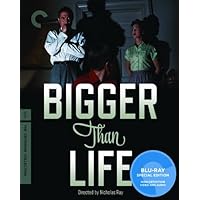
 Talk about a film ahead of its time, Nicholas Ray's 1956 drama Bigger than Life tanked upon release in the US most likely because of its dark, brooding and unflinching observations on suburban life (the film is partially based on Ray's own childhood, if I'm recalling correctly.); people back then didn't want to be told about the monster next door, and to a lesser extent people today still don't want this, but Ray's film is so perfect in every respect that one can't look away from the screen for a moment.
Ray, like Fuller, unfortunately was, more or less, wholly ignored in the US during his life but was immensely popular with the Cahiers kids and I'm glad to see that in the past decade or so his films, besides the popular Rebel Without a Cause, are getting some serious reevaluations.
-----
Here's the details, for those interested, in regards to the Criterion release:
* New, restored high-definition digital transfer, with uncompressed monaural soundtrack on the Blu-ray edition
* Audio commentary featuring critic Geoff Andrew (The Films of Nicholas Ray)
* Profile of Nicholas Ray (1977), a half-hour television interview with the director
* New video appreciation of Bigger Than Life with author Jonathan Lethem (Chronic City)
* New video interview with Susan Ray, widow of the director and editor of I Was Interrupted: Nicholas Ray on Making Movies
* Theatrical trailer
* PLUS: A booklet featuring an essay by critic and video maker B. Kite
-----
Here is to hoping that they get their hands on Johnny Guitar.

Mild-mannered schoolteacher Ed Avery (James Mason) works hard to provide for his wife Lou (Barbara Rush) and young son Richie (Christopher Olsen), secretly working after-hours as a taxi switchboard operator. When Ed is struck down by a debilitating and potentially fatal illness, doctors prescribe wonder drug Cortisone, and it seems to do the trick. Ed feels more confident than he has in years, and loves to spoil the family with expensive trips to the department store. But Ed's dependence takes a darker turn when he begins taking the pills in larger quantities. Lou and Richie can only stand by helplessly as Ed angrily lashes out, hurling abuse and insults at his wife and son. The mood swings only get worse as the weeks wear on, to the moment when Ed finally cracks completely...
I won't try to spoil any major plot points. BIGGER THAN LIFE will surprise and shock you with it's hard-hitting subject matter, and the frank way it's depicted was I'm sure the main reason why the movie flopped in 1956. It's well and truly the flipside of "Father Knows Best". Today the movie still rings true because so many families are dealing with similar issues on a daily basis. James Mason and Barbara Rush are completely mesmerising to watch here. Child actors from the 1950's are normally very mannered and "trained" on screen, but young Christopher Olsen is heartbreaking as the tortured Richie; his performance absolutely rings true. Walter Matthau, Kipp Hamilton and Roland Winters are also very fine.
Buy Bigger Than Life (The Criterion Collection) (1956) Now
***** 1956. Directed by Nicholas Ray. A teacher, suffering from a rare and painful disease, accepts to take cortisone, a new drug in the 50's, under medical surveillance. Unfortunately, the patient modifies his prescriptions and becomes little by little psychotic. This undisputable masterpiece presents in 95 minutes all the major Nicholas Ray themes: an idealistic hero who can't accept his average destiny, the bitter study of the American way of life and a smart use of the new Technicolor technology, with its new space offered to the directors, to name a few. Some scenes, like the scenes with the mirrors, are already part of Movie History. You can now buy a zone 2 DVD of BIGGER THAN LIFE at Amazon.fr with a perfect copy of the film and very interesting featurettes about the themes handled by Nicholas Ray in this film. A DVD zone your library.Read Best Reviews of Bigger Than Life (The Criterion Collection) (1956) Here
Nicholas Ray has long been one of the most underrated directors. He may have been recognized and respected for his groundbreaking Rebel Without A Cause, but his much of his output was long ignored by mainstream audiences and critics alike. The tide has recently been shifting and Ray's other output has begun to receive the recognition it deserves. Bigger than Life is Ray's 1956 effort concerning mental illness, drug use, and the 1950's family structure.Bigger than Life tells the tale of Ed Avery, a good-natured school teacher who in the hard 50's is juggling an additional job at a Taxi company to provide for his family. As the pressure of everyday life and these two jobs mount up, he notices certain bouts of pain and even a few blackouts. Dismissing these episodes, it later becomes obvious to him and his family that he is unable to keep up with daily life in such a way. A specialist tells him that he has a very rare inflammation of the arteries; a condition that would grant him only a short few months to live. The only way of combating this disease is a new experimental steroid hormone called Cortisone. This abuse of this drug which Ed must take for the rest of his livelihood in has extremely adverse effects such as Psychosis, a condition with symptoms such as hallucinations and impaired judgment.
Ray's treatment of Ed's abuse of Cortisone is simply jaw-dropping. The audience continually waits and waits for a violent outburst, an outburst that literally tears the family apart-but it doesn't happen. Ray could have easily taken this condition and created a violent and physically abusive monster, but he keeps Ray controlled. On the surface, besides his little conspiracy and new-found ideologies Ed does not seem to be effected in a major way by the drug. Ray knows that if he transgresses toward violence and abusive, his film will become the average deleterious suburban family film. The film eventually does display Ed's breaking point, emotionally and psychologically, but does it with such subtle consideration that its arrival surprises and shocks. Ed's eventual violent outburst has such an unexpected biblical context that we uncontrollably grin at the screenplay's shrewd inclusion of this incident. It's not only the late inclusion of the Ed's biblical revelation, nor his alternation of it, but Ray's provocative method of approach.
Bigger than Life ushers back the era where films were not only simple in their approach, but even the conflicts were more clearly and effectively constituted. In Bigger Than Life, the adverse effects of the drug are so carefully displayed that at certain times it just seems as if he has gone through a spiritual and philosophical revelation. Ray treats psychosis as psychosis should be treated: multi-layered and channeling multiple symptoms. Nowadays, film freely display mental ill patients, such as Schizophrenics, as beginning at the peak of the disease, either with a single noticeable symptom or suddenly with all symptoms. Rarely do they spend time developing and showing the meager signs of mental illness, and eventually displaying the illness in its most domineering stages.
Bigger than Life is so focused in its approach to Ed's illness that it is overwhelming. There is no subordinate plot that disrupts the story or the audience's attention. The film is a reflection, a dark one, of the effects of drug use and how such use tears apart a man's soul, his family structure, and even is capable of turning him into a man that is unrecognizable in behavior, attitude, and demeanor. The underlying concept that Ray seems to continuously point towards is what makes a man? Is Ed still Ed after his experience with Cortisone? He looks like the previous Ed, and he responds when he is called by his name. However, no one seems to recognize him, his family does not recognize this deranged perfectionist father and husband with these newly developed ideas; even the milkman does not view Ed as he did before. Ed may be literally kept alive due to the Cortisone, but the drug drenched all of his personality and left everyone only with a shadow of the previous schoolteacher.
Bigger than Life was largely attacked and criticized after its release due to its skeptical view of the American family structure-not unsurprising, considering that it was released in the mid 50's. Ray's film may lack the jolting electricity it had for viewers at the time of its release, as such adverse effects of drugs have become better known and treated, but its unique and considerate approach still makes it one of the most , deftly executed, underappreciated, and singular cinematic works ever.
Want Bigger Than Life (The Criterion Collection) (1956) Discount?
This 50s film on American suburbia now released on DVD sure packs a punch into the solar plexus of conformity. Mason,producing as well,gives one of his best performances in a Jeckyll and Hyde role.Ray was one of the great American directors.His use of colour was symbolical and expressive.His use of wide-screen Cinemascope opens up architectural space inside a suburban home.The use of light and shadow and camera angle to bring out extremes of emotion and a character's inner life and phantasy.Rush is superb as the supportive but anxious wife,Lou.Olse is excellent as Ritchie the son.And Mattau comes across well as an eccentric but affable colleague and family friend.He is concerned about his colleague's changes in mood and supports the wife and son.The subject is,superficially,the use/abuse of a 'wonder drug',Cortisone,to heal Mason's physical disease.If he doesn't take this drug he is expected to live for only another year,and in crippling pain.However Mason takes more than he should,pretends to be a doctor,writing out his own prescriptions.This unlocks a pandora's box of psychosis and patriarchy:"God was wrong",he declares, Abraham should have sacrificed Isaac. He is about to sacrifice his son with scissors after shutting his wife away in a cupboard. He is the template for any dictator, now his inner-Nietzsche has been liberated.I loved everything about this long lost masterpiece.Mason is unforgettable and brings the best of his acting skills to the part.One for the collectors
Save 38% Off

No comments:
Post a Comment