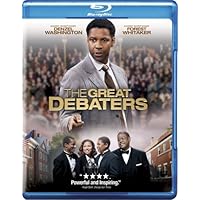
 `The Great Debaters' offers what great movie viewing is all about. Based on a true story, the film takes us to Wiley, an African-American Methodist college in Texas during the Depression in 1935. Inspiring, harrowing, and uplifting, the film gives proper transcendence especially during a time and place that didn't offer many breaks.
We are first introduced to Professor Polson (Denzel Washington), a tenacious idealist and poet. As professor at Wiley and debate coach, he hardly yields on any of his principles. Inspired by the man who is named for the heinous lynching, Polson tells his debate recruits that it was in Lynch's best interests to keep Black people, "Physically strong, but psychologically weak." It is with this explanation that we understand his zealous approach to his debate team, and why he makes their training so rigorous.
Entering the field are forty-five tryouts, of which, only four will be selected: two representatives and two alternates. Of the three who make it, we get to know Henry Lowe (Nate Parker) a charismatic and bright figurehead who is easily distracted by beautiful women and hard liquor. Joining him are Samantha Booke (Jurnee Smollett), the first young woman to join the debate team, and James Farmer, Jr. (Denzel Whitaker) forever young at age 14, but an ever resourceful scholar and son of a minister, James Farmer, Sr. (Forrest Whitaker). [No real life relations.] As he notices a romance start to blossom between his teammates, his resentment grows. As the one who researches many of the arguments Henry and Samantha provide on the podium, he is put on the sidelines both in terms of the limelight and the love light.
As you might guess, Wiley enjoys a certain amount of success, and the price of success is opposition. Polson spends a great deal of his time and rhetorical talent organizing a sharecroppers' union, much to the chagrin of Sheriff Dozier (John Heard) who won't have unrest in his sleepy Texas town. In one scene the Farmer family is making a trek by car on a rural country road as they pass a poor white farm. The children who seem so mischievous run alongside the car as they pass along, unaccustomed to seeing a "Negro" with an automobile. Perhaps distracted by the nearby children, he runs over a pig, and in a quietly intense exchange between Farmer, Sr. and the owner, is extorted of a month's paycheck. This reminded me of a similar scene in the 1980's movie, `Centennial,' and showed the contrast between a good film with a similar theme and a great one.
In another part, the debate team makes their way by night to their debate destination when they come across a truly horrible sight. What they see through the windshield reveals a mob of white men who don't like having their heinous deeds brought to light. Shaken, they each try to come to cope with their discovery as they often lose focus and courage in the face of Polson's opposition and the violence laid before them.
Always kept in check by their unyielding leader, the debate team holds out for all possible opportunity. Audacious but unflinching, Polson invites Harvard to a debate match. One of the master strokes of the movie is how the debates and their topics match the action that goes on all around them. Show and tell is mixed expertly for a meaningful movie experience.
`The Great Debaters' is a top-echelon movie experience. Although it is reminiscent of movies like Mississippi Burning, To Kill a Mockingbird (Collector's Edition), and Akeelah and the Bee it captures a fulfilling true life story in a way that doesn't feel like rehash or contain a wasted scene. (Directed by Denzel Washington and screenplay by Robert Eisele)

I never expected a movie about a debate team to be intense, scary, or exhilarating, but "The Great Debaters" is all that and more. There are two stories here one is the debate team and the other is life under segregation; both stories are compelling. The acting is uniformly outstanding; Forrest Whitaker and Washington support some lesser-known, but extremely talented young stars. We get to know their characters and care about them as they overcome their various obstacles to become the top Negro college debate team in the country.
The injustices of segregation are vividly and heartbreakingly portrayed; it was quite a sobering look at the legalized cruelty of that time and place. The fact that this is a true story makes it all the more inspiring. Heartily recommended.
Buy The Great Debaters (2007) Now
I first heard about THE GREAT DEBATERS when my friend and I were browsing through the antique shops of Arcadia, LA. The owner of one of those shops told me that several pieces of furniture out of her store had been purchased to use in the movie. That was fascinating. When you watch the movie, you'll have so much to see -all the rich historical drama and good acting of a suspense-filled plot -that you may not notice the authenticty of the set, including the furniture. If you buy the DVD, you will have enough interesting things to watch again and again.It is sad to realize how things were in the 1930's in the part of the world where I live. This movie portrays the horrible way black people were treated. This story of Melvin B. Tolson, played by Denzel Washington, gives background information about the Civil Rights movement. Tolson's 1935 debate club at Wiley College, Marshall, Texas, stunned the nation. (I won't give the end of the plot away!)
Langston Hughes, the famous poet who authored "A Dream Deferred", visited Wiley College and said, "Melvin Tolson is the most famous Negro professor in the Southwest. Students all over that part of the world speak of him, revere him, remember him and love him." Tolson was active on many levels. In real life he was an English and speech professor, labor organizer, modern poet, novelist, debate coach, drama coach, and football coach! His methods were radical. At times while I watched the movie, I was anxious about some of his behavior as played by Denzel Washington. It is amazing that this man was not lynched.
Instead, the professor did just fine and eventually left Wiley College to teach in Oklahoma. Wiley College, located in east Texas between Dallas and Shreveport, is doing fine too. In fact, it continues to thrive and has one of th best teacher-student ratios in the nation.
I digress. Back to the movie, I admired the writers and producers, along with Denzel Washington (the director) for having the courage to tell the truth. The movie protrays painfully true pictures of both blacks and whites of the time. It shows the oppression of intelligent black people by uneducated white people. It also shows the conflicts within a young black man who struggled with issues related to moving into adulthood. The pain he caused a young woman is played with sensitivity.
To modern educators, the students may have seemed wooden in their debates. The professor rehearsed the students and taught them by rote.
In our time, we are so eager to make all our students independent thinkers that we do not achieve the discipline that made these debaters successful.
THE GREAT DEBATERS is much more than a movie about social causes. It is a beautifully acted and produced work of art.
Read Best Reviews of The Great Debaters (2007) Here
THE GREAT DEBATERS is an interesting historical look at the first black debating team to ever compete at a white college. And although it is interesting as a film, it isn't very historically accurate.The good is that, as a film viewer, you care about the main characters. Denzel Washington (Deja Vu) stars in -and directs -this ethnically challenging movie, and does so in his usually adequate way. Melvin B. Tolson (Washington) is the teacher of the Wiley College debate team in 1935 Texas. His team is comprised of three bright young black people: Henry Lowe (Nate Parker), an overly-clever man with a possible future ...if he can stay out of harm's way; Samantha Brooke (Jurnee Smollett, House, M.D.), the first female debater in Wiley College history; and James Farmer Jr. (Denzel Whitaker), a chubby lad with a penchant for research.
Growing up in the South (that's South with a capital "S"), the team must not only fight to win debates against local colleges, but must also battle the prejudices of the times. They come into close contact with ignorance and racism on a daily basis. Even their teacher, Mr. Tolson, is threatened at various crossroads.
This is what stood out in the film ...and rightfully so. But there were some serious flaws in the film, too. The biggest was the debates themselves. Many of them were based on emotion and not facts and statistics. It would've also been nice to have had the names of the actual persons within the film and not some made-up ones (some were real, like Tolson, but others were not).
Some praise has to be made for Forest Whitaker (The Last King of Scotland) as Dr. James Farmer Sr. His role was understated and held much of the powerful, emotional punch toward the final third of the movie, especially when his son James Jr. discovers why his father reacts the way he does during an embarrassing prejudicial moment.
That Wiley's black debaters made it to Harvard and debated their team is now history. But I would've liked to have seen more of the actual history than this Hollywooded version. Still, it's an interesting movie that'll give many viewers an insight into something they probably knew nothing about.
Want The Great Debaters (2007) Discount?
This movie takes us back to an ugly time in U.S. history -the Jim Crow era. In a segregated little town in Texas, the African American teachers and students of tiny Wiley College pursue excellence in education and recruit a world-class debate team, good enough to take on the debaters of Harvard and win.I'm not sure how much of this movie is fact and how much fiction but it pushed all the right buttons with me. Denzel Washington, who directed, plays the debate coach Melvin Tolson. He is fiercely intelligent, proud, politically active, angry, fearless and demanding. Washington makes him truly convincing. His debate team includes a 14-year-old budding genius and a brave young woman breaking gender and race barriers as well as a philanderer with a roving eye. Forest Whitaker plays the 14 year-old's father, a preacher with an angry exterior but a soft heart.
The movie explicitly shows the humiliations blacks suffered living in the South, including a horrific lynching. It portrays the self-hatred such scenes inspired in blacks who had to suffer them without the power to do anything about them.
One interesting aspect for me is the movie's constant refrain that education is the way out of this poverty and humiliation. By training their intellects, African Americans can reclaim their autonomy, confront their oppressors and build a better life, the movie argues.
I am afraid this lesson has been lost somewhere along the way. In those days, people paid good money to watch colleges debates and they were even boradcast on national radio. Today, we're all about glorifying rap singers and basketball players. All our communities, but especially the African American community, are the poorer because of it.
The documentary accompanying this movie shows some of the real-life characters who inspired it. You listen to those fierce, passionate, articulate, educated voices and you not only are filled with admiration for them but you also bemoan the state we've reached now.
This movie isn't perfect. It's a little formulaic perhaps. But its strengths far outweigh its weaknesses. It's good entertainment that also carries a message we need to hear.
Save 59% Off

No comments:
Post a Comment