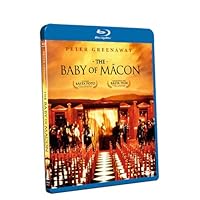
 Director Peter Greenaway, no stranger to making films with an OTT content made this The Baby Of Macon in 1994. It was slammed by many critics for being too OTT (even by Greenaway's standards) and indeed many of the audience who did show up to watch it, tended to walk out in disgust at some of the sequences. The film faded quietly away in cinemas and its subsequent releases on both vhs and dvd tended to do the same... That is a shame because while the film has its flaws, it has strengths which propel it into 4 star territory.
The film is of the recreation of a stage play put on for a bloated aristocrat. The play is about the lurid events that happened in the French town of Macon during Medieval times. However, reality and what is being played blur and soon the audience find themselves participants in the events which become increasingly (and at times disgustingly) real.
The story sees a hideously overweight and ageing woman give birth to a beautiful baby. The townspeople are incredulous that this could happen which allows one of the woman's older daughters, a manipulative and scheming individual, played by Julia Ormond to claim that the baby is hers, and arrived via a divine conception. The child does seem to have powers of healing and blessing and as his guardian the young woman is soon on her way to making a fortune from payments from those eager to benefit from the child's seemingly divine powers. However, events later take a turn for the worse and the Church is shown in an unflattering light, as it makes an unpleasant intervention when things start to spin out of control. Indeed, Greenaway is essentially accusing the Church of being a self serving institution, more interested in the maintenance of power and control, rather than carrying out its historical mission.
Be warned the gore and sexual content is very strong indeed. The graphic sex scene between Ray Fiennes and Julia Ormond is then followed by the incredibly gruesome death of Fiennes' character.
Julia Ormond's character is sentenced to be raped by over 200 men by a vengeful Church official....
The child dies and is graphically dismembered on screen by the adoring townspeople as they each seek a 'relic' from his body.The net result of this OTT content is that it tends to dilute and blur the film's message rather than underline it though.
Gore aside, the film is sumptuous to look at and the costumes are an explosion of colour and detail. The film boasts a strong cast that includes Ray Fiennes, Julia Ormond, Don Henderson and others.
To sum up, watching The Baby of Macon is an experience, you could hardly call it entertainment. However, it remains a film that should be seen. The New Zealand dvd (which at the time of writing) is the only official dvd release, has been cut but is still very gruesome. If you wish to see the uncut version of the film, then pick up a UK release vhs. Just make sure that you have a strong stomach.....

Greenaway's Incredible Vision...
If one can imagine a moving fusion-synthesis of Van Eyck's Ghent Polyptych with Bruckner's Symphony No. 8 and Sade's Misfortunes of Virtue, stretched to a mind-bending cinematographic time-scale, then ye may have some idea of Peter Greenaway's Baby of Mâcon (1993).
Greenaway is a very curious artist who seemingly combines some type of obsessive drive with numeromania and a hatred of the body with hyperaesthesia, resulting in a cinema of compulsive fascination.
Tarrence Rafferty famously critiqued Greenaway's The Cook, the Thief, His Wife & Her Lover (1989), shrewdly noting in part, `[Greenaway] obviously regards himself as an aesthetic virtuoso, but he's just a cultural omnivore. (He chews with his mouth open--we can identify almost every piece of art that has fed his imagination.) The only thing in this movie's hermetic universe that Greenaway is unable to control, or disguise with fancy brushwork, is his loathing of the body. What's offensive about the picture [is that] Greenaway is an intellectual bully: he pushes us to the ground and kicks art in our faces.'
This applies as well to virtually all Greenaway's work.
Greenaway's other great films include The Pillow Book (1996) and Prospero's Books (1991).
*
============
Technical Notes: disc made in Sweden; excellent transfer 2.39:1 aspect ratio; PAL (which runs faster than NTSC) 117 mins. Appears UNCUT.
============
*This DVD was authored incorrectly. It should be framed as a 2.35:1 anamorphic image, but instead is "squeezed" so that everything inside the frame is stretched vertically and looks taller, probably to a 1.85:1 image. If you have a dvd or blu-ray player that upconverts, you can finnagle the image and eliminate the problem, but people with regular dvd players don't have that option. The manufacturer needs to fix this. The film is visually stunning, and should be presented properly.
Read Best Reviews of The Baby of Macon Here
In 1993, during his foray into experimental CD-rom technology in filmmaking with works such as The Tulse Luper Suitcases and Prospero's Books, Peter Greenaway put together what may very well be his most challenging picture as well as his most infuriating and it was The Baby of Mâcon. The picture is, essentially, a parable on the story of the birth of Christ, except that it is not Christ that is born but rather a child whose destiny lies in bodily exploitation by the people of faith and desperation that surround him. The story tells of a poverty stricken village that is on it's last legs before total desecration upon film start. A monstrously ugly woman, whom we never see the face of, gives birth to the most beautiful baby boy the villagers have ever seen. Unable to cope with the idea that such a hideous woman could have given birth to a creature of such beauty, innocence, and purity, the woman's daughter (Julia Ormond) proceeds to claim the child as hers and that it was a virgin birth. Upon proving to the villagers her virginity, she locks her own mother away in tepid solitude and exploits the child's sheer existence by having him perform blessings. Eventually she is met with a disbeliever (Ralph Fiennes) who is the only skeptical character in the entire picture. When she allows the man to try and take her virginity, the child interferes and monumental disasters result.Here's where things get complicated. The film's storyline doesn't actually exist in the context of the film, but in fact on stage in front of an audience of what looks like exaggeratedly high class citizens who appear to be viewing this play as some sort of dark comedy. Throughout the play, the viewer sees the audience's reactions as well as the actual cast members backstage discussing the play, actors discussing their roles, characters putting on make-up, child performers playing and dancing, and the main performers quietly rehearsing their lines. The film is split into five acts, which include a brief prologue and a brief epilogue. We see the actual viewers enter into the audience shortly after the prologue, so we get into the storyline before the actual viewers do. When the film ends, the cast of the stage production bows to the audience who in turn proceed to turn around and each bow to the audience behind them and so on and so forth until we get to the end to which the audience in the very back of the auditorium bow to us. The film also features moments in which the actual onscreen actors briefly interact to the audience in the forefront of the stage, which, early on, is received with laughter. There is actually much laughter early on in the film, but the laughter dies down more and more as the film continues. So with The Baby of Mâcon, Greenaway is balancing two worlds within his world; the world of the arts and the world of the exhibitor. However, there are times in which Greenaway decides to blur the two worlds into one. There are a series of atrocities depicted on stage at several points of the film (from disembowelment to rape), and Greenaway decides to call questions of reality into it in a very jarring and rather discomforting way. He does this in surprisingly subtle ways which I will get more into later, but I feel the reason why he did this was to illustrate the film in a theatrical way so as to pull in themes of over elaboration when it comes to discussion of faith and religion. I feel that with this film Greenaway is mocking religion for what it is rather than what it does and what it represents in the grand scheme of things. Putting aside my personal feelings toward religion, I don't see this film as anything less than hateful in it's views, but that does not mean that Greenaway's intention was to pick apart faith and religion. I see the film as more a celebration of the artistic representation of religion than anything else, and this has everything to do with it's distinct presentation.
To put it mildly, watching The Baby of Mâcon is a very weird experience on a lot of different levels. I'll try and start off with the easy aspects and then work my way deeper and deeper into each progressively obtuse theme of this picture. One of the major themes of the film is excess. The film does not shy away from excessive behavior, but it is a hell of a lot more vivid than one is most likely picturing in their head. Greenaway makes sure that when things get messy that they get messy in a big way. Like most of Greenaway's films, The Baby of Mâcon is shot using mostly mastershots. Unlike most of his films, however, this technique isn't used to distance the audience from the action, but is used more as a way of allowing us to take in as much over-the-top imagery as possible. What I find immediately troubling about this film is it's excessive details. For starters, the costumes are even more exaggerated looking here than they were in The Draughtman's Contract. Everyone in the film speaks in an overly enunciated and resplendent way, and the effect is frighteningly uncomfortable. Nearly every statement is a question on top of a question, and much of the dialogue early on is full of stylized vulgarity. This is to demonstrate the characters as jaded rather than suffering so as to allow the audience to find them relative in a non-sympathetic way. It is difficult to describe the style due to the fact that it is performed for the film's audience rather than the real viewing audience, but it never comes across as too shallow or distant to us. The film's structure, admittedly, does take some getting used to. However, it is a style that comes out more fluidly upon repeat viewings. Upon first viewing, however, the characters merely exist as pawns in a sort of fable about the troubles of religious belief rather than religion itself. Upon first viewing, the bridge between the two is merely hinted at. Themes of both, however, begin to gradually grow more clear throughout the film when we begin to see the actual reactions of the actors. We see so little of the actual actors playing these characters, however, that we can only pick up on subtle acting choices in order to determine what sense of stylistic progression they are trying to further within this twisted screenplay of faith followers gone amok.
To continue on to subsequent details of note, the tragedy of the story comes across as more an ironic Coup de grâce to the audience who has to suffer through the onslaught of misery and insanity. The film is an orgy of suffering, for those who are unprepared, and the audience is forced to come face-to-face with the content of the film itself rather than the storyline. The odd part is that they never seem to quite mind. I see this as a sort of quasi-response to those who complained about the content in Greenaway's The Cook the Thief His Wife & Her Lover. The graphic violence and sex in that film had meaning and emotion to it, and what Greenaway clearly wanted to do was make a purely adult film with adult themes, adult situations, adult humor, and adult content without having to restrain himself to provide enjoyment for the politically correct, the fainthearted, and the narrow-minded. That film's world was completely quaint compared to this film's world, with characters dressed in such garish colors and overly structuralist set-pieces. Twenty minutes in, after much loud and excessive verbal diarrhea from the cast with it's borderline clown make-up and their seemingly endless fawning statements over the genitals of the little boy who runs around in his birthday suit throughout about seventy-five percent of the film, you cannot help but begin to wonder what insane asylum Greenaway decided to shoot this film in. It eventually sinks in that the world of Peter Greenaway is not a world to be questioned, nor is it a world to which anyone should expect any sense of normalcy. There isn't a concept of normalcy in sight. You couldn't write crazier characters if you were forced to. These are all characters that act under a strict onscreen guide that propels them to indulge in unadulterated maniacal outbursts onstage that we witness more than we watch.
All of Greenaway's films feature humanity, sometimes at it's most delicate. The Draughtman in The Draughtman's Contract, the three women in Drowning By Numbers, Albert Spica in The Cook the Thief His Wife & Her Lover, and even Nagiko in The Pillow Book are all examples of humanity, whether it be at it's most humane, it's most inhumane, or it's most passionate. Hell, just about all the characters in Prospero's Books had a lot of life and lust for life in just their physical mannerisms alone, and that was one of the things that made that film such a joy to watch. The Baby of Mâcon does as well, and that of course is in the child. However, unlike in other Peter Greenaway films, this character that represents humanity is meant to be an example of it as well. Because of this, the audience has nothing in this work to hold sacred. Peter Greenaway actually doesn't allow the audience any sort of personal touch to be satisfied by. It's almost a combination of themes from all of his more major previous films. We have the theme of feminine control from The Draughtman's Contract, the theme of beauty in unexpected locations from A Zed and Two Noughts, the theme of sacred tradition that is touched upon in Drowning By Numbers, the theme of violence and decadence from The Cook, the Thief, His Wife, & Her Lover, and the theme of storytelling found most prominently in Prospero's Books. The difference here is that those themes explored in those films were done in a legitimately fascinating and exploratory way in which the viewer could rewatch them and pick out more and more images that further represent these sorts of expressions. Here it is forced upon us in both a visual manner and in a manner of storytelling. Peter Greenaway is shoving all of these intense thoughts down our throats and expecting us to be able to at least comprehend some of it. These images and ideas throw themselves out at the viewer in a manner that is far too fast and too abrasive for virtually anyone to be able to appreciate. This is, ultimately, why The Baby of Mâcon is such a problematic film for me despite the fact that it is undeniable Greenaway successfully made the film he set out to make. So as I mentioned above, yes the child represents humanity. But it so obviously represents humanity that it becomes painful for us to accept his fate in the large scheme of things. When we are confronted by the nonbeliever, we can already tell that he comes as a kind of omen. However, the film is so artistically expressed that it grows rather into a tasteless realization in the fact that the story is about to become like a biblical tale. That is why, in the end, it dawns on us that this story is more a fable than anything else. And yet even the fable becomes perverted due to Greenaway's insistence on depicting evil in behavior rather than in a learned thought process.
One thing I can definitely say I do appreciate about this film is how much this film's universe is expanded on repeat viewings. Upon viewing this film a second time, I had grown used to the acting styles of the actors that I was able to see them less as actors and more as characters. I understood more of their choice in line delivery and in action expression. It became a much more useful and thought-provoking piece with this in mind. I understood why certain backdrops were used and I could comprehend more characters, and trust me when I say that there are A LOT of characters in this. One thing I can also safely say is that once you are familiar with the disturbing content of the film, you won't have to concentrate on those details as much of repeat viewings due to the multiple images that you will continue to discover. On a second viewing, I was able to digest the film much easier. Unfortunately, the film also gave me a case of Stendhal Syndrome that was most unpleasant, and this isn't the only Greenaway film this has happened with. The film is, in essence, far too artistically beautiful and meaningful. It is extremely hard to mentally absorb some of the imagery on display here, and for that it becomes a disturbing film to just plain look at. That's ultimately the only real issue with the film. Greenaway did too good a job at making this film disturbing. It is physically, mentally, and logically offensive. It's an assault on the senses, so to speak, and with that he has certainly succeeded at making something deeply memorable.
The last thing I wanted to comment on was yet another detail that I didn't notice until this second viewing. This film's satiric elements are very interesting. This is a film about the theatricality of religion, but it is also a film about the theatricality of art. Mel Brooks briefly touched on this in Blazing Saddles, as did Alejandro Jodorowsky in The Holy Mountain, but here Peter Greenaway does not shy away from the fact that the simple concept of this film makes little sense in a theatrical setting. For example, what theater stage on what planet would house an entire village, a town square, a church, a dungeon, a barn stable, and a full scale bedroom? Those aren't even all the rooms and setting located here. The film makes practical use of the scene transitions, but it would take hours and hours to build sets of this magnitude. This is how Peter Greenaway transcends the stage medium and the film medium. He turns his stage world into the real world of this film and the real world of the audience. The result is deeply deeply pessimistic, maddening, and completely unfair to the casual viewer. And yet, you can sense that he knows this, is commenting on it, is taking it seriously, AND is exploring the concept all at the same time. To me, that is the most daring thing this film does and that is the hardest concept for any casual viewer to ever be able to wrap their heads around.
So that's The Baby of Mâcon, Peter Greenaway's most challenging film. This is not a film I can safely recommend to anyone, not even those with unusual taste. Even Greenaway fans will likely find the film to be overly cruel. The film does not have the usual Greenaway touches that many would come to expect. There are no numbers, no codes, and no complex alphabetical explorations. The film is an artistically excessive exploration on artistic excess, a religious parale, a religious satire, a satire of the art world, a satire of the stage, a representation of theatrical powers, an exploration of excess, a story of sin, a story of desperation, a story of insanity, a study on realism, and an experimental clashing of film, stage, and reality all set during an exaggerated version of 1659 that is itself part of a stage play that is unveiled in the final moments of the film. The film also has some of the best performances of the careers of both Julia Ormond and Ralph Fiennes, who both get to gleefully show off the depths at which an actor will go to in order to truthfully bring to life the vision of a director. This may be a representation of the deranged mind of a sick man, but it is also one of the most challenging films I've ever seen and therefore I cannot deny that it is nothing short of breathtaking and brilliant. It is brilliant in the most sick way possible.
FOR MORE REVIEWS LIKE THIS, GO TO 7capitalfilms.blogspot.com
Want The Baby of Macon Discount?
First--it's great to be able to get this film in the US more easily. Second--this is the BEST I've ever seen this film. The aspect ration is correct, the clarity and color are AMAZING, and the sound is wonderful. Finally, we've gotten a copy that doesn't blur out the nudity (as did many copies that came from older Asian prints) and gives the proper aspect ratio and good picture quality (it's a revelation when compared to the previous Austrailian dvd--a good product, but still inferior).Anyone who liked this movie will be stunned when they see this blu ray. No extras and no subtitles, but, that's not a big problem.


No comments:
Post a Comment