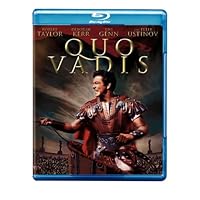
 "Quo Vadis", based on the novel by Henryk Sienkiewicz would have to be near the top of my list of favourite 1950's religious epic productions. Indeed "Epic" is the word to fittingly describe this mammoth MGM production that cost an amazing 7 million dollars to make in 1950 and was the studio's biggest money maker since "Gone With The Wind". It has everything an epic movie lover could desire, the already stated fine literary source, breathtaking sets (no computer generated effects here!), meticulously researched historical costumes, enormous crowds scenes and a stunning recreation of Pagan Rome at it's height. The film boasts an extraordinary cast but towering over all of them is the late Peter Ustinov in his unforgettable performance as the deranged Nero. His interpretation of this infamous Emperor who began the first concentrated persecution of the early Christians is still the visual image for a lot of people, myself included,that first comes to mind when Nero's name is mentioned. Already having been filmed a number of times in the silent era and once again since this 1951 film, this is still the definitive version of the story of the early Christian Church struggling to survive in Nero's Rome after the great fire.
With the advent of television in the early 1950's Hollywood fought back with splashy, lavish productions that could not be matched by the flickering black and white image of television in it's infancy. "Quo Vadis", lent itself perfectly for this purpose and an already shaky MGM put all of it's resources into the filming of this elaborate production. The story centres around cocky Roman soldier Marcus Vinicius (Robert Taylor) who after three years of successful campaigning returns to savour the delights of Nero's Rome. Detained at the villa of a retired Roman general Marcus falls for the simple charms of the general's adapted daughter Lygia (Deborah Kerr) who unbeknown to Marcus is secretly a Christian. Seeing her love for him but not understanding the families belief in the love of a single god and in loving your fellow man despite their background or race Marcus has Lygia taken to Rome and placed in Nero's "House of Women" and seeks to make her is own. Lygia escapes and is taken in by other believers but in the meanwhile Marcus finds himself the focus of the unwelcome and quite dangerous affections of the Empress Poppaea (Patricia Laffan). Meanwhile Nero's meglomania continues to grow and he develops a wild scheme to rebuild Rome to his own glory and secretly sets the city on fire. The backlash from this act however sets Nero to find a scapegoat and thus begins the persecution of the Christian sect that are, to the amazement of the Romans, the disciples of a simple young carpenter from Galilee who was executed for his beliefs. Marcus finds Lygia however both are imprisoned together as Christian believers to become the sport of Nero's festivities in the arena. The appearance of the Apostle Peter who has been called to Rome by Christ's message gives the Christians the strength to endure their ordeals and Marcus and Lygia are married by him just prior to his own matrydom on Vatican Hill. Nero however goes too far in his persecution and the mob turns on him resulting in his fall from power and suicide and the reins of power being taken over by the more level headed General Galba.
While "Quo Vadis", in some areas is not always accurate historically the faults are not glaring ones and it does give a vivid picture of the growth of the early Christian movement and the persecution it endured which of course went on long after Nero's death. First and foremost it is inspiring and dramatic viewing and is the classic example of old style movie making at its most lavish. The film is filled with unforgettable images, for example the huge crowd scenes during Marcus' triumpiant entry into Rome, and the burning of the city by Nero which incredibly was done on both full sized and miniature sets. The cold blooded destruction of the Christians in Nero's Circus of course is probably the most vivid image in the film and is riverting in it's horror and accurate depiction of people being eaten by lions or being used as human torches. These scenes in "Quo Vadis", have I believe never been bettered in depicting the insanity and brutality of Nero and his regime. Performances are uniformily fine here. As the two lovers Robert Taylor and Deborah Kerr are just perfect as the two illmatched lovers from different worlds. Finlay Currie does a most inspirational piece of work as Peter and special mention must go to Patricia Laffan who is perfect in a chilling performance as the evil Empress Poppaea. Directed by MGM veteran Mervyn LeRoy, who was responsible for such diverse MGM productions as "Waterloo Bridge", and "Blossoms in the Dust", here he is still just as at home with this super scale type of film and his directoral integrity is evident in every frame of this film. "Quo Vadis", ended up being nominated for 8 Oscars including Best Picture and Best Supporting Actor for Peter Ustinov.
I always find "Quo Vadis", a moving viewing experience generally around Easter time when my thoughts often go back to the earliest years of my religion. Liking the older style of movie making I can also appreciate the film on its superb technical achievements and massive historical recreation. This however never submerges my appreciation of its very simple message that all people need to love each other despite their differences for the world to be a happier place. Take time soon to view this epic production of "Quo Vadis", you wont regret it.

Everyone knows the popular legend. Nero burns Rome to clear the way for the magnificent city he wants to build, but the peasants are revolting literally. He then blames the odd and unpopular but quickly growing sect of the Christians for the burning, and begins feeding them to the lions for the amusement of the Romans. However, the Christians face death so bravely that Rome turns on Nero. Well, that's the movie.
The facts are much more in argument. In an ancient city such as Rome, accidental fires that destroyed cities were common. In fact Nero did lead a massive relief effort after the fire, and fires just as large broke out in Rome after Nero's death. Some historians do have the Christians confessing to the crime. The fact is that the people did begin to circulate rumors that Nero was at fault, and he was responsible for blaming th Christians for the fire to save himself. He ordered to have them thrown to dogs, though, not lions, as in the film. However, like Showtime's "The Tudors" one can somewhat overlook all of this historical jumping to conclusions and outright inaccuracy in the name of fine entertainment.
Special Features
Disc 1
Commentary by F. X. Feeney -Filmmaker/writer Feeney explores the genesis of one of M-G-M's most glorious, grand-scale productions
Theatrical trailer
Teaser trailer
Disc 2
Commentary by F. X. Feeney continued from Disc 1
Documentary -In the Beginning: Quo Vadis and the Genesis of the Biblical Epic This documentary walks the road as long and complex as the film itself, from its roots as a Nobel Peace Prize-winning bestseller to its various ground-breaking adaptations to its place as the most daring and lavish film that MGM, and Louis B. Mayer, dared to undertake.
Technical notes: Quo Vadis was made prior to the advent of widescreen projection and stereophonic sound. It is presented, as in its original theatrical release, with a 1.37:1 aspect ratio and monophonic soundtrack. Because of its extreme length and detailed photography, WHV has spread the film over two discs in order to maximize bit-rate and insure the highest quality picture presentation."Quo Vadis" is a great film Directed by Mervyn LeRoy, Starring: Robert Taylor, Deborah Kerr, Leo Genn and Peter Ustinov with splendid cinematography, fabulous sets and costume designs, magnificently photographed by Robert Surtees. "An Spectacular True 1950Th's Classic."
This jewel of a movie "Quo Vadis" whose copyrights are owned by "TIME-WARNER INC." it's nonetheless still sitting idle at their MGM/UA Turner Collection's Library without any official restoration on DVD, even when released in 1951, it did became the 2nd highest box office take in "Hollywood's Film History." Surpased only by the epic "Gone With The Wind."
The restoration should be presented in a format preserving the aspect ratio of its original theatrical exhibition. But unfortunately right now, only some appalling import copies of it are circulating the internet, selling some for over $35 a piece.
I can't comprehend why Time Warner Home Video have not noticed this problem and take some action to correct this oversight sooner rather than later. So at this point, that "The Studio" is about to re-issue in September 13, 2005 the "Collector's Edition of Ben-Hur." We feel that "QUO VADIS," which also was produced by Sam Symbalist, could become a very profitable asset, if only this film that deals with "The First Judeo/Christian Holocaust" is put on a fast track by Warner Brothers for a late 2005 release in conjunction with the "Collector's Edition Ben-Hur."
Ideally along also with two other classic films that are at Warner Brothers Film Library Vault. The first one "Land of The Pharaohs" by Director Howard Hawks, Starring: Joan Collins and Jack Hawkins (who also starred in "Ben-Hur.") This film screenplay was done by no other than the great American writer William Faulkner. The second feature is "The 4 Horsemen Of The Apocalypse," Directed by Vicente Minnelli, Starring: Glenn Ford, Ingrid Thulin, Charles Boyer, Lee J. Cobb and Paul Heinreid, Co-starring: Paul Lucas, Yvette Mimeux and Karl Boehm. It's a searing drama, in which the Nazi monster set brother against brother following the family's destructive linkup to the sinister horrors of Nazi Germany. A perfect match for another very profitable Warner Brothers DVD release dealing whith this Nazi subject matter: The legendary Luchino Visconti's "THE DAMNED."
All these Great Classic films of "Hollywood's 1950Th 'poque" should already have been released on anamorphic widescreen or presented in a format preserving the aspect ratio of its original theatrical exhibition on DVD. Unfortunately, perhaps due to an oversight by someone at Time Warner Studios, all of them are still gathering star dust at "Warner Brothers Film Library Vault." Without generating any revenues for The Studio or otherwise providing to us some pleasurable joy when we add them to our "DVD Home Video Collections."
Can somebody please remind "TIME-WARNER INC." that they still got "These Three Golden Classic Movies" waiting to be released on DVD, which also can be very apropos films for the times we live.
Read Best Reviews of Quo Vadis (2009) Here
Quo Vadis is the absolute best movie that never won an Academy Award. At the time of its release in 1951, it was the 2nd highest box office of any movie in history (Gone With the Wind was the highest). It was the first of the many historical epics of the 1950's and early 1960's. It is also the best.Robert Taylor plays Roman general Marcus Vinicius, commander of the 14th Legion, and Deborah Kerr portrays a Christian lady, Lygia, that he falls in love with. Lygia is a hostage of Rome and Vinicius arranges with the mad Emperor Nero (Peter Ustinov) to have her reassigned to him. She runs away to the shelter provided by other Christians for fugitives from "Roman justice."
Meanwhile, Nero wants to go down in history as being the greatest artist of all time. He is assisted in trying to come up with both ideas and proper wording by Petronius (Leo Genn). These scenes are great fun as Petronius does a wonderful job as the emperors' faithful counselor, and with his great wit manipulates the pompous and vicious Nero. By doing so, he helps protect the Roman populace from the evil emperor.
Also going on at this time is the growth of Christianity in Rome. Both Saint Paul (Abraham Sofaer) and Saint Peter (Finlay Currie) are present in Rome. The 2 saints hold services in the Roman catacombs. Christianity is a secretive religion since the adherents of Christ are under constant threat of persecution.
Eventually, Nero gets the idea that for him to create an artistic masterpiece, then suffering on a colossal scale must first take place. He orders his chief yes man, Tigellinus (Ralph Truman), the commander of the Praetorian Guard, to set fire to Rome and also to block the escape of the Roman population across the bridge to achieve maximum slaughter. Tigellinus carries out Nero's cruel decree and one of the greatest fires in history resulted. After Nero announces both his decision and also his plans to rebuild Rome under the name "Neropolis," Vinicius bolts and goes to Rome in his chariot and succeeds in overcoming the Praetorians at the bridge to save multitudes from death.
The Roman people quickly figure out that Nero was the "incendiary" resposible for the burining of their beloved city. However, Nero decides with the help of his slutty Empress Poppaea (Patricia Laffan) that in order to deflect the blame from him, a victim needs to be scapegoated. From there, he decides that the Christians, who refuse to engage in worshiping the emperor as a god, make the best victims. Nero then decrees that it was the Christians who burned Rome and as such, they are to be all rounded up and fed to the lions in the colisseum as public entertainment.
Quo Vadis is a magnificent major motion picture. It has beautiful scenery, wonderful costumes and fantastic cinematography, and is as accurate a capture of ancient Rome as was possible with 1951 technology. The set designs are sheer artistry. Quo Vadis is a stunning spectacle with an excellent script, fine performances and holds up very well today.
The best part of this movie is Peter Ustinov's performance as the mad Emperor Nero. Ustinov is totally focused on the role so much so that he captures the screen in the scenes that he is in. Ustinov's performance is the absolute best portrayal of Nero yet given by an actor in a movie. Ustinov plays the role instead of converting the character into a reflection of himself. Ustinov should have won the Academy Award for his performance. He did, however, win the Golden Globe.
Thus far, Quo Vadis is the absolute best Roman epic ever made. The decor, costumes, and art direction certainly have not been matched by anything that followed, including Spartacus, Ben Hur and Gladiator. Quo Vadis is an excellent movie that is certainly well worth your time.
Want Quo Vadis (2009) Discount?
I echo the sentiments of the previous reviewer. Why this film has not been released on DVD is bizarre.However many titles have been ignored in the transfer.
EL CID
Sodom and Gomorrah
Samson and Delilah
Keys of the Kingdom
Shoes of the Fisherman
A.D.
Certainly some of these films are poor and others are outstanding, however for some odd reason, the studios have chosen to ignore these titles. My thought, at the time, was that like "The Cardinal", some of these films would have been remastered and released on the coattails of the magnificant "The Passion...". Unfortunately, this is not so.
Quo Vadis may be a definitive chapter to any Catholics's collection of outstanding films in an age where orthodoxy is a no-no in the motion picture circuit.
To ignore it is a disgrace.
Save 23% Off

No comments:
Post a Comment