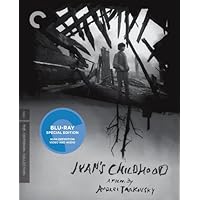
 This is a DVD to own. "Ivan's Childhood" is Tarkovsky's first and arguably his most famous film. Based on Vladimir Bogomolov's early novella, "Ivan" (that is, "John") (1957), the film achieved wide acclaim outside Russia. It was produced at the risky time when Premier Khrushchev's era was ending and fundamentalist Marxists were ascendant again, restricting freedom in the arts; it is, as one observer wrote, "one of the harshest, morally complex versions of the war in Soviet film." It won the Golden Lion award at the Venice Film Festival. With this debut film, Tarkovsky established an international reputation that has influenced many other filmmakers.
Except for this novella, Bogomolov is not widely known outside Russia. However, it was translated and anthologized widely around the world. Look for Bernard Isaac's translation into British English. It has the atmosphere of reality. It is punctuated it with references to real places, the Dnieper River, the town Gomel, where Ivan was born, and the Trostyanets death camp; even official Red Army and SS documents have an authentic flavor.
The novella is told in the first person narrative of a Red Army lieutenant. Ivan is about 12 and a "scout", or reconnaissance spy, sneaking across the swampy Dnieper River into the night and behind German lines. The war made him an orphan and filled him with maddening hatred and desperation for revenge. He has been with partisans, in a death camp, and wounded by friendly fire returning from a mission one night. The soldiers are amazed he's been through so much.
There is the pun, of course: Ivan's last name is Bondarev, Ivan Bondarev, that is, John Bond. In the story, it's an intelligence cover name. However, Ian Flemming's first James Bond novels appeared in the early fifties before "Ivan" was published. It may be coincidental, and probably only of interest to Western readers.
Writers often insert their own lives and experiences into their writings, and Bogomolov served in the Red Army in World War II and in intelligence. I do not know if Bogomolov based Ivan on any real person that he may have met or learned about. I guess we can only speculate about Ivan, yet a child working as a war-time spy seems plausible to me. After all, in the desperate chaos at the close of the war, Germany mobilized the Hitler Youth and insurgent units called Werewolves. There is plenty of historical evidence pointing to child combatants throughout history as well as in current events. We recall that Baden-Powell, who created the Boy Scouts, was a former soldier and spy, and the crafts of scouting are important reconnoitering skills used in war. The world is as morally conflicted as ever.
Though he argued with Tarkovsky about the way his story was filmed, like all authors, I think Tarkovsky's approach was correct, considering the demands and possibilities of the cinemagraphic medium. This Criterion Edition of the film is cleaned up with a high definition digital transfer. There is a new subtitle translation. The highlight of the features is the interview with Nicholai (Kolya) Burlyaev, who portrayed Ivan. He reminisces how he was cast at 14 and how the film was made.
The film follows the novella closely, though it takes a more objective viewpoint and enters Ivan's troubled dreams, which make striking imagery. It is tragic poetry whereas the novella is matter-of-fact. Here, Ivan is somewhat bratty and hot tempered. Though he is a child scout, I think the film suggests that he may not be the only one. He knows his trade-craft and takes it very seriously. Still, no one seems overly concerned (in either film or story) that a child is a war-time spy. Frankly, he insists on doing it. Ivan's only friends are the soldiers who want to care for him (after the war)or send him to school but do not object to his missions.
The film, shot on location at the Dnieper River, is pregnant with dramatic, almost heavy-handed imagery and symbolism. There is the first metaphor of crossing the river. Then there is the metaphor of the dead tree. It's his extraction point where Sgt. Katasonov waits for him to bring him ashore to safety. But, Ivan misses the rendezvous because of German patrols and must swim further away. Here, one metaphor abuts another. At the end, following Ivan's last mission, Tarkovsky re-introduces the dead tree metaphor as Ivan races laughing on a beach, perhaps in whatever kind of dream that may have come for him. There are other interpretations, and this one satisfies me now. At the end of the day, we have Bogomolov's poignant story enhanced by Tarkovsky's uncompromising, haunting vision.

It is actually a very remarkable movie and one that the world took notice of (including ingmar bergman who was influenced a lot by this movie)..
This is the work of a young director experimenting with a new cinematic technique.. The results are very interesting and Ivan's childhood remains a classic of 60's cinema..
Buy Ivan's Childhood (Criterion Collection) (1962) Now
Here is what Tarkovsky said about the picture: I attempted to analyze the condition of a person who is being affected by war. When personality is disintegrating then we have the collapse of the logical development, especially when we are dealing with the personality of a child. I alsways conceptualized Ivan as a destroyed personality pushed by the war from the normal axis of development. A lot, more than a lot, everyhting that was appropriate to Ivan's age was gone from his life, and in its place he was bestowed with evil endowments of the destruction that concentrated within him and seized him. The film was based on a striking short story titled "Ivan" by an obscure Russian author named Bogomolov, who himself probably was in SMERSH, a Red Army field recon and counterintelligence during the war as much dreaded as Stalin's NKVD. Tyhe way the way the story waas written, it was probably inspired by true life experiences. Ivan himself could have been invented, or it might have been based on a real life incident, as there were a number of adolescents and pre-adolescents executed by the Nazis and martyred by the communists after the war. The story provides a lot of details into the running of military intelligence agents, the trench warfare and the role of secret police in totalitarian police in teh Red Army during the war. The story takes place in the trenches and gives good detail of the machismo of the Red Army reconnaissance scouts. The story gives a good description of life in a politicized army in a totalitarian country familiar to most older Russians, but not in such detail. None of that background made it on celluloid. The book reads like a personal tragedy for the kid involved, a feeling lost when the story was transferred on film, which was more symbolic. Here is what makes sense in the book, but is not made significant in the film: The two corpses hanging in the no man's land where the two scouts who were supposed to meet ivan at the Dead Tree who were killed in the ambush, mutilated, and hanged by the germans as a warning. The girl who flirts with the recon lieutenant is from a different story by Bogomolov, where an infantry lieutenant survives a frontal attack on the enemy trenches only to find out that his new fiancee was killed in the rear during the action. The Dead Tree to which Ivan runs in his final dream sequence is the extraction point which he didn't make the last time because of the german patrols. Ivan's surname in the movie in Bondarev, probably play on Bond. Were Bond films out in 1962? In the written story Ivan is a lot more human and is corrupted by the affiliation with elite soldiers and better food rations of an intelligence unit he is with. In the book the kid actually talks down on the exhausted infantry lieutenant who initially detains him. In the book are scenes of his adult friends corrupting him with nice clothes and other trinkets, which never made it into the screenplay, nor were there the scene of his handlers coaxing Ivan to go again behind the German lines when he gets scared. In the story, the narrator is the lowly lieutenant guy who tries the rescue the kid, and then learns of his final fate. In the story, incidentally, the kid is turned in to gestapo by a greedy peasant for a few bucks. All in all, the story is realistic and smacks of human tragedy, while the movie is a lot more symbolic. The film gets 5 stars though, because the film is one of the best representations of the mark that the War left on the collective Psyche of the people who lived in the Soviet Russia at the time. 1941 was the first year when the ration stamps were repealed and that spring was the first time in the decade perhaps that the people were looking for a summer of relative peace and prosperity, and then the war happened, interrupting graduations and honeymoons, starting another five years of major hardship. See if V. Bogomolov was translated into English. If he is not available on Amazon, try the Russian store, Four Continents in Washington, DCRead Best Reviews of Ivan's Childhood (Criterion Collection) (1962) Here
This is Andrei Tarkovsky's first feature film, and it's wonderful. It doesn't have the epic feel of grandeur and astonishment of his later work, and it's quite conventional compared to the mystery and ambiguity of films like Solaris and Stalker, but it's still very good and has to be seen by anyone who loves Tarkovsky, Russian cinema, and cinema in general. The film was not actually instigated by Tarkovsky himself. The original director had quit/got fired, and the production was going to be shut down. Tarkovsky, fresh out of the Soviet film school, took the film on, and made it his own. I'm glad that Criterion is releasing this, as earlier VHS and laserdisc copies weren't the greatest transfers, and some material had been cut (mostly the stock WWII footage that Tarkovsky used at the end of the film). For those who don't like Tarkovsky later, lengthy, abstract films, you may like this one, as it is much more straightforward, but still definitely a Tarkovsky film.Want Ivan's Childhood (Criterion Collection) (1962) Discount?
This review is for the Criterion Collection DVD edition of the film.Ivan's Childhood releaed in the Soviet Union as Ivanovo Detstvo is about a boy of about 12 named Ivan, who assists Soviet soldiers during World War II. It is the first studio film by acclaimed director Andrei Tarkovsky.
This was first announced as an upcoming relaease by Criterion almost 10 years ago and is finally available. I have no idea the reason for the delay. It has some good scenes in it and is well photographed.
The DVD also contains interviews with cinematographer Vadim Yusov (who worked on Tarkovsky's other films) and the film's lead actor Nikolai Burlyaev who played the title role. Also included is an interview with Vida T. Johnson, who wrote a book about Tarkovsky.
Save 13% Off

No comments:
Post a Comment