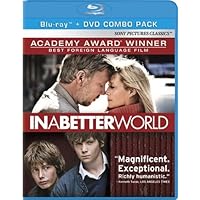
 There is no denying the message brought out in `In a Better World'. Susanne Bier (god, I love her) has a way of working with situations and actors to create such visceral chemistry. I've seen all of her works, and while `In a Better World' is far from her strongest (just watch `After the Wedding' and tell me it isn't one of the single greatest cinematic achievements of the past decade...I dare you) it still carries her trademark aura.
`In a Better World' explores a different theme for Bier. Here she tackles violence, its root and the steady escalation of untreated anger. It is within this theme, and the overall construction of its elements, that the film falters for me. While I find it more compelling than the lauded `A History of Violence', it doesn't quite capture the unsettling realities of violence that any one of Michael Haneke's masterpieces has done (especially `Cache'). Instead, `In a Better World' is a little too calculated for its own good. I actually loved the assessment given by the sites reviewer, Robert Horton. He states "this film is rendered with great care and each new strand of the plot is thought out and carefully placed...maybe, if anything, slightly too carefully placed--the story is so neatly plotted and balanced it comes close to being a closed system", and I concur with this sentiment. The film is so obvious in its construction that the eventualities bare less impact than they would if there was that element of surprise, and that element is a big one when considering violence as an act. Violence is often senseless and careless and unwarranted, and while this film touches on those areas (school bullies, ruthless warlords) it doesn't allow that energy to seep into the skin of the picture.
`In a Better World' deals with dueling families affected by various degrees and expressions of violence. Anton is separated from his wife Marianne after his indiscretions catch up with him. While he is off in Africa taking care of women ravaged by a disgusting warlord, Marianne is taking care of their son Elias who is suffering emotionally by the torment of a school bully. Claus, recently widowed after his wife lost her battle with cancer, is trying to repair his relationship with his young son Christian, who has witnessed Elias's treatment and has retaliated with a burst of violence that left the tormentor bruised, battered and scared. Christian begins to fray though, using this situation not as a stepping stone for change but instead, he spirals down into a morbid and vengeful spirit as he contemplates exacting revenge on anyone who treats him or those around him unfairly. Anton, who is absent in Africa most of the time, tries to set a good example in `being the bigger man' for his son and his son's friend, but Christian's attitude continues to derail as his pent up anger over his mother's death pushes him to the edge.
The performances are all outstanding, especially from young William Johnk Nielson, who infuses so much emotional complexity behind Christian's eyes. Trine Dyrholm is also very good here. I've only seen her in two films (WATCH `TROUBLED WATER' NOW!) and she's been exceptional in both. I loved Ulrich Thomsen in Bier's marvelous `Brothers', but here I'll admit that he has little to do. Mikael Persbrandt is extraordinary as Anton (he sounds like a Swedish Alan Rickman), developing such layered emotions as he struggles to be a father and a role model and a friend and when he begins to tamper with his own moral and ethical boundaries you can see the confliction in his soul.
In the end, `In a Better World' is a beautiful film. It has so much going for it (the score, the cinematography and the set designs are just a few of the extras that make this film completely eye-catching), I only wish that it wasn't so mechanically `exact' because it loses a bit of its heart in the process. It becomes `expected', which takes away from the wonderment of the experience.
Still, Bier is an exceptional filmmaker!

Well, if a Danish film entitled In A Better World fills you with expectation the drought might finally have broken, save your money. It is, instead, a pretty harrowing drama, beautifully staged and acted, as close in tone as I can think to Swedish Romantic-Horror Let Let The Right One In. Which is to say, grim.
The opening titles are projected downward onto a scene of sandy African hinterland cropped in such a way that it might be a close up of a banana. From there we open on a painterly tableau: a sweeping African landscape vaulted over by a heaving, boiling sky. The locale of the film switches between here and autumnal, coastal Denmark, between which Anton, a field doctor divides his time.
We also have parallel stories: Elias, Anton's son, is bullied at school. His home is also fractured: not only because Anton spends most of his time in an African refugee camp, but also because Anton's marriage is falling apart.
Christian is a new boy in Elias' school, transplanted out of a wealthy London boarding school following his mother's death from cancer. We first meet Christian as he flawlessly, but coldly, delivers his mother's eulogy over her coffin. In an early playground confrontation he comes to Elias' aid and reveals himself as a fearless child with a destructive streak. Elias quite the opposite can't believe his luck to have found a protector and latches onto him like a remora. Christian is a passable shark.
Meantime, Anton continent-hops and deals with his own sort of bullying: there are unpleasant goings on in the refugee camp, courtesy of a sadistic local war lord, who has been creating most of the trauma patients in Anton's clinic. Anton has a principled, but unworldly, commitment to the hypocratic oath, even if that means healing the war lord when he suffers an infected wound. Anton is bullied also back in Denmark, where he is as much of an outsider as he is in Africa: he's Swede.
So, nicely set up: we have fractures and bifurcations everywhere you look: between Denmark and Africa; between husband and wife; between Anton's theory and the boys' practice. But all under the same, brooding sky a visual repeatedly imposed on the screenplay: for all the localised fractures everything is part of a continuum: everything is under the sun. Well, clouds, at any rate.
The drama is very tightly worked and the pacing is perfect: whenever the pot nears the boil, we cut between Denmark and Africa so as to delay gratification, and the suspense keeps growing. Michael Persbrandt plays the Anton well, with fittingly piecing blue eyes. The children leads are terrific too: Markus Rygaard captures the eager but guileless Elias and William Johnk Nielsen is excellently cast as the scowling Christian.
As the premise implies, events set a course for tragedy and make all haste getting there: the family bonds in each family have worked themselves loose enough to be unable to avert disaster. This, I think, is Susanne Bier's industry: to investigate how the western veneer of settled social organisation (perfectly exemplified by the social democrat Scandinavians) doesn't need much of a scratch to come apart.
Anton's moment of revelation comes as his war lord, healed, shows no sign of remorse or gratitude and he realises there is a limit to philosophical theorising in the face of a nasty, brutish and short life. I doubt such a credulous or idealistic European would last long in that sort of environment in real life, but as a narrative device it works well.
Bier's conclusion, which I won't spoil, struck me as a little pat, but in the round this is a clever, tense, and well produced drama.
Olly Buxton
Buy In a Better World (Two-Disc Blu-ray/DVD Combo) (2010) Now
It's funny how Hollywood spends so much money making these big special effects films and yet most of them (Not all I'll admit) pale in comparison ACTING wise to European, Latin American (Argentina for example) films. Movies like "In a better world" have the upper hand when it comes to excellence in acting. I love this movie for many reasons, because it shows the delicate and complicated relationships between fathers and sons and most of all it shows emotions in a very realistic sense without being sappy or overly sentimental,something that Hollywood is very good at doing. A very HIGHLY recommended foreign film.Read Best Reviews of In a Better World (Two-Disc Blu-ray/DVD Combo) (2010) Here
I was very reluctant to view this subtitled film due to a misconception that it was an overly preachy, overidealized paean to pacificism. Truth be told, it is much more complex, and provides a sensitive examination of human nature and the competing urges toward bravery, cowardice, evil and humankindness. To the viewer, it pulsates with excitement and danger. By design, a number of scenes are emotionally overwhelming and excruciating to watch--but without artifice, special effects or superficiality. Highly recommended without any reservation.Want In a Better World (Two-Disc Blu-ray/DVD Combo) (2010) Discount?
"In a Better World," an Oscar-winning Danish-Swedish drama (Best Foreign Language Film for 2010), follows two thematically-related stories set in different locations: Africa and Denmark. Anton (Mikael Persbrandt) is a Swedish doctor who had moved to Denmark, but now lives in Africa as a dedicated member of a group providing medical services in a refugee camp. But the people in the camp are horrified by "Big Man," a sadistic warlord cutting up pregnant women.In the meanwhile, Anton's son Elias (Markus Rygaard) and a new boy at school Christian (William Jøhnk Juels Nielsen) become friends when Christian beats up a schoolboy bullying Elias. Christian's mother recently died of cancer, and the strained relationship with his father Claus (Ulrich Thomsen) is not getting better.
Then two things happen: Anton is humiliated by a mechanic Lars (Kim Bodnia), who slaps him in the face, and though Anton tells the boys to ignore him, Christian disagrees. (The Danish film's original title "Hævnen" means "revenge.") And in Africa, when the "Big Man," now severely injured, is brought to the camp, an idealist Anton's belief is tested.
The plot gets markedly melodramatic as the film moves into the second half, where the two boys and their parents have to face the consequences of their actions. Acting is unanimously strong, especially from the two boys, and director Susanne Bier handles the convoluted story skillfully.
Or maybe she does it too skillfully. The film wraps everything up too neatly, and while we understand the point she is trying to make by juxtaposing two events at totally different places, I'm afraid the melodramatic narrative may be oversimplifying the complexity of the issues the film is dealing with.
Like her previous works (including "After the Wedding" and "Brothers"), Susanne Bier tells us a story of people in an extraordinary situation, and she is quite good at it. These stories are often very emotional but not sentimental. Flawed as it is, "In a Better Place" is a compelling drama with believable characters.
Save 68% Off

No comments:
Post a Comment