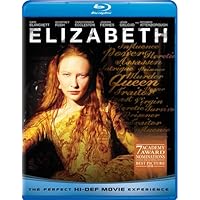
 This is a magnificent film with a stellar cast giving award calibre performances. Cate Blanchett deservedly won the Golden Globe Award for Best Actress in a Drama. She is truly the heir apparent to Bette Davis and Glenda Jackson, both having portrayed Elizabeth I in memorable performances. Cate Blanchett now joins their ranks with her own incredible performance in that role.
The movie begins in 1554, in an England that is bitterly divided on the issue of religion. Ruled by Mary Tudor, Henry the VIII's oldest daughter and a devout catholic, protestants are being burned at the stake as heretics, giving rise to Mary's popular name, "Bloody Mary". Reviled by her Spanish husband and in poor health, Mary is badgered by her advisors to do away with Elizabeth, her considerably younger, bastard half-sister. This Mary will not do, no matter how pressed. Still, Elizabeth lives her life with the sword of Damocles hanging over her head at all times.
When Mary dies, Elizabeth takes the throne, no more than a mere slip of a girl wearing the crown of England. Her advisors look to guide her, and she follows their lead, until she determinedly takes control of the reins of power, and follows her own counsel with the help of her most trusted advisor, Francis Walsingham, played to cunning perfection by Geoffrey Rush. With his help, she is able to fend off the ever present threats to her hold on the throne of England, not just from her own courtiers, but from Marie de Guise, Queen of Scotland, deliciously played by Fanny Ardent.
In the film one sees the transformation of Elizabeth take place. She goes from being a young woman, really no more than a girl, who is in love with Robert Dudley, the Duke of Leicester, dashingly played by Joseph Fiennes, to the commanding woman history would ultimately come to know as the Virgin Queen. Confronted cruelly with the politics of intrigue and betrayal, she learns that to stay in power and effectively lead her people, she must rule with her head and not with her heart. She succeeded brilliantly, leaving a rich legacy that would be remembered as the Elizabethan era.
This film is an absolute masterpiece. While not quite historically accurate, the film is a broad overview of what happened when Elizabeth first took the reins of power. It also attempts to explain why Elizabeth I would be known as the Virgin Queen. This film is a lush and lavishly costumed medieval tapestry that is woven with great care. It is, without a doubt, a magnificent movie that will hold the viewer in its thrall. Bravo!

As others have noted, this film is entertainment, not history. The writer(s) mixed fact with pure fancy, and compressed many authentic episodes that occured over 40 or so years into the beginning of the reign. Walsingham did not kill Marie de Guise, nor did he oust Cecil as Elizabeth's primary advisor. Robert Dudley was not involved in any murder plot. I won't bore you with the rest of the laundry list.
I think it only fair to point out that in my opinion, despite the inaccuracies, the writer(s) did manage to give a fairly accurate view of some major aspects of Elizabeth I's entire reign. She did use possible marriage as a political tool. And she was damned adept at doing so. Elizabeth did have a more moderate religious policy than either of her two predecessors.
The movie is worth watching. And, if seeing it whets your curiosity, read any of the several popular level biographies of
Elizabeth I. Alison Weir's _The Life of Elizabeth I_ is very well written.Among Great Britain's monarchs, two queens stand out in particular: Elizabeth I. and Queen Victoria. Both came to power at extremely young ages, and at times of political instability which would have set the odds of survival against any new ruler, but particularly so, against a woman. Both beat those odds in ways few people would have foreseen: They not only persevered but ruled for a nearly unparalleled long time, and during their reign achieved to both strengthen England's economy and international stance and give new direction to its society. We have long come to identify their reign as "the Victorian Age" and "the Elizabethan Age," respectively. Yet, while "Victorian England" is an expression often used synonymously with moral conservativism, Elizabeth I. fostered not only the development of science but also the theater and arts; providing fertile ground for the works of Shakespeare, Marlowe and many others. (Influenced by her husband, Queen Victoria supported the exploration of new scientific developments, but the dominant force of her formative years as a ruler was conservative prime minister Lord Melbourne, who once advised her not to read Dickens because his books were "full of unpleasant subjects.") And while Queen Victoria derived strength from her long, stable marriage to German-born Prince Albert, Elizabeth I. resisted the pressure to marry at all and became known as "the Virgin Queen."
Looking back at Elizabeth's reign, we see less a woman than an icon; the symbol of what her rule has come to stand for. Shekhar Kapur's 1998 movie explores, as the director explains in the DVD's "Making of" feature, the making of that icon; the formative processes, influences and personalities surrounding the young princess's ascent to the throne and her first years in power and of course, at the center of it all, Elizabeth herself, magnificently portrayed by Cate Blanchett (who should have won the Academy Award for her performance). The princess, as this movie sees her, certainly knew her insecurities about her role in life and in English politics, her people's expectations, and the intrigues of her own court. But she was also, as Kapur has her affirm to her protector and spymaster Walsingham, "[her] father's daughter" the proud, headstrong daughter of Henry VIII., who quickly learned from her mistakes and assumed true leadership early on. Having inherited a country deeply torn in religious conflict, and having barely survived the machinations of the court of her Catholic half sister and predecessor, "Bloody" Mary I., to find her, the "heretic," guilty of treason and execute her, one of Elizabeth's first acts in power was to have parliament pass the Act of Uniformity, reestablishing the Church of England formed by her father. And while she respected her Secretary of State Sir William Cecil, she eventually came to realize that his advice was overly guided by the hope that she marry and produce an heir to secure her kingdom, and she reluctantly retired him into his status as Lord Burghley.
Indeed, there was not one single man who dominated Elizabeth's life but several, and Kapur was able to secure an extraordinary cast to surround then-newcomer Blanchett. Richard Attenborough plays Sir William Cecil with a humility and quiet dignity that few besides him could have brought to the screen. Christopher Eccleston bristles as the powerful, ambitious Catholic Duke of Norfolk, that key player from the inner circle of Mary's court who retained his position after her death and became the one member of Elizabeth's council most dangerous to her reign. Joseph Fiennes reprises his role as a burning-eyed, handsome lover from the almost simultaneously released "Shakespeare in Love" (which, while a splendid movie in its own rights, eclipsed much of the limelight that "Elizabeth" would so richly have deserved), playing the man most closely romantically linked to Elizabeth, "Sweet" Lord Robert Dudley, Earl of Leicester, whose love for her at least, as this movie would have it is ultimately his own undoing. "You're still my Elizabeth," the erstwhile princess's lover insists at a ball some time after her coronation. "I am no man's Elizabeth," the queen retorts, and affirms for all the court to hear: "I will have one mistress here, and no master!"
Most impressive of all the queen's men is Geoffrey Rush's portrayal as her protector, secret advisor and supreme spymaster Francis Walsingham, the creator of what much later became Britain's MI-5, whose role Rush approached, inspired by the description Kapur had given him, much like the Hindu god Krishna, as "a very wise man who can kill people ... while smiling," as he explains in the DVD's "Making of" featurette an ability which his young, unfaithful companion in exile learns to know as much as powerful Marie de Guise (Fanny Ardant), aunt to Elizabeth's would-be suitor Henri d'Anjou and mother of her later rival Mary of Scots; who had refused Henry VIII.'s suit remarking "I may be big in person, but my neck is small," only to find herself terminally surrendering to Walsingham's unmatched cunning.
Key to any great historical movie is the authenticity of its production design, and "Elizabeth" overflows with the rich and luxurious colors of the queen's renaissance court and its balls, gowns and pageants. But there are also the vast, high stone halls of the palace and the royal cathedral, symbolizing the perpetuity of the monarchy reestablished by Elizabeth I. At last, when contemplating a statute of the Virgin Mary, Elizabeth wonders whether, to perpetuate her reign, she must be "made of stone;" and it is again Walsingham who answers: "Aye, Madam, to reign supreme, [because] all men ... must be able to touch the divine here on earth" and as yet, "they have found nothing to replace [Mary]." And so, this movie tells us, the icon we all know was created and like a nun married to God, a dehumanized Elizabeth reenters her council and holds out her hand to her old Secretary of State: "Observe, Lord Burghley: I am married to England!"
Also recommended:
Elizabeth I: Collected Works
The Life of Elizabeth I
Elizabeth R
Elizabeth I
The Virgin Queen
Elizabeth The Golden Age (Widescreen Edition)
Shakespeare in Love (Miramax Collector's Series)
The Wives of Henry VIII
Read Best Reviews of Elizabeth (1998) Here
Queen Elizabeth I of England is one of the most impressive figures in European history. She came to the throne in 1558 at the age of twenty-five, upon the death of her half sister, Mary I. It was a time of much political instability, and the young Queen's task was made even more difficult by the fact that her legitimacy was by no means universally acknowledged (many saw her father Henry VIII's marriage to Elizabeth's mother, Anne Boleyn, as being invalid, since he was never granted a Papal dispensation for the annulment of his first marriage to Catherine of Aragon, Mary's mother), and by the fact that Elizabeth was a Protestant. And on top of all this, many of the English people were far from jubilant at the prospect of another female ruler, after the disastrous reign of her sister Mary. The years immediately following Elizabeth's ascent to the throne, therefore, were fraught with uncertainty and danger. In order to retain her crown and win the hearts of her people, Elizabeth would have to become a strong, almost superhuman figure, and it is this formative process that the film "Elizabeth" seeks to show us.Unfortunately, the film does not entirely succeed. Elizabeth reigned for 44 years, an extremely long time. Her maturation and the development of her status as a national icon were shaped by a series of trials, both political and personal, that took place over the course of multiple decades. It would be nearly impossible to accurately show all this in a 2-hour movie. "Elizabeth" suffers from the fact that the makers of the film simply tried to cram too much material into the 124 minutes they had to work with. It could be called a "Cliffs Notes" version of Elizabeth's story the film provides a sketchy overview, but you wouldn't want to rely on this as your primary source of information. Many events are truncated, jumbled together, and even shown out of historical order, with the effect that they make very little sense. One would have to have considerable knowledge of Elizabeth's life before seeing the movie to really understand what is supposed to be happening in many of the scenes. The relationship between events is not readily apparent from the movie itself. But the problem, for those that come to the movie with previous knowledge if Elizabeth, is that they will also notice all the historical inaccuracies in the film. And there are many.
For one, there is no evidence whatsoever that the relationship between Elizabeth and Robert Dudley was ever sexual, yet very early on in the film there is a sex scene between the two. That they loved each other very much is undisputed, but Elizabeth was rarely left alone, even in her private chambers, being almost constantly attended by her ladies in waiting, and there would have been very little opportunity for her to let the relationship go so far. Furthermore, Elizabeth would have been aware of the inherent risks in having a sexual relationship primarily that of becoming pregnant. In addition, she knew she could never marry Lord Robert, for he was already married to Amy Robsart (and she did indeed know of this, though the film seems to imply that she was unaware of it prior to Cecil's announcement of the fact), and Dudley was also extremely unpopular with most of the members of court, and it is unlikely that Elizabeth would have risked her throne a very real danger by carrying out a sexual affair with him.
Even more confusing, the latter part of the film implicates Dudley as a co-conspirator in a plot against Elizabeth. This makes no sense at all. Though there were times when the real Dudley incurred the Queen's displeasure, and fell temporarily out of favor, their disagreements were usually short-lived, and the two remained good friends their entire lives. Dudley's last letter to Elizabeth was a love letter, and when Elizabeth herself died years later, this letter was found on the table beside her bed. Another discrepancy is the fact that the Duke of Anjou shown in the film is the wrong Duke of Anjou. Elizabeth was indeed courted by Henry, Duke of Anjou, and he did indeed cross-dress, but he never visited her. Much later his younger brother Francis, who took on the title after Henry ascended the throne of France as Henry III, took up the suit of Elizabeth, and he was the one who travelled to England. But he was never known to cross-dress. The film also implies that Francis Walsingham conspired to assassinate Mary of Guise, regent of Scotland. First of all, it was Cecil and not Walsingham who was sent to Scotland, and secondly, Mary of Guise died of dropsy. There are numerous other, more minor inaccuracies, but it would be tedious to list them all here. For more information on the real Elizabeth, I highly recommend the biography "The Life of Elizabeth I" by Alison Weir.
On the flipside, the film is saved by Cate Blanchett's magnificent portrayal of Elizabeth herself. Blanchett definitely deserved her Golden Globe Award for Best Actress, and she alone is the reason I actually added this movie to my collection. She is also the only reason I would ever have even watched this movie more than once. Blanchett has a very strong screen presence, and really captures the intricacies of Elizabeth's character. She is the backbone of the film, without which it would undoubtedly have crumpled into a shapeless mess. The other actors primarily Joseph Fiennes as Robert Dudley, Richard Attenborough as William Cecil, Geoffrey Rush as Sir Francis Walsingham, and Christopher Eccleston as the Duke of Norfolk do admirable jobs, but the ways in which the film skews their characters undermine their performances. The only other thing I would really commend this film for is its costuming, which is magnificent. Elizabeth's wardrobe alone is stunning. The DVD Special Features are decent, though not overly impressive. There are two trailers, two featurettes on the making of the film, a photo gallery, and information on cast and crew.
Want Elizabeth (1998) Discount?
'Elizabeth' is a movie along the lines of 'Braveheart'a fantastic spectacle that plays fast and loose with the historical facts in order to make a good show. Although I found it sorely lacking in the historical accuracy department, the mood, feel, scenery, costuming and lighting come close to atoning for that.Taking place at the inception of Elizabeth I's reign, you're transported back to Elizabethan England. We're privy to some of Elizabeth's most intimate moments, and watch as she grows into an unsure young girl into a competent ruler, who ultimately becomes one of England's greatest monarchs.
The acting is superb, save for an over-the-top portrayal of a middle-aged, ill and hysterical Queen "Bloody" Mary. Cate Blanchett eerily resembles the real Elizabeth, and delivers what should have been an Oscar-winning performance. The supporting cast does an admirable job as well, and all should be congratulated for the apparent ease with which they endured being attired in Elizabethan-period clothing!
All in all, the scenery is fantastic, the costumes breathtaking, the music haunting, and the acting first-rate. The only thing which I found annoying is the disregard for real historywhich, in this instance, is even more compelling than the 'fact based fictional movie'. Some stories need embellishment; that isn't the case with Elizabeth's. Yet despite that, this movie stands on its own and shouldn't be missed.
Save 47% Off

No comments:
Post a Comment