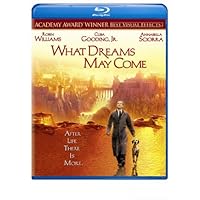
 There is such a profound sense of drama, magic and emotion behind the story in "What Dreams May Come," a film based on the novel by Richard Matheson. There is a strong story with which anyone who loves someone else can identify, as well as an austentatious and elegant scope of visual and auditory imagery that jumps right for your eyes onscreen. Matheson's visions of heaven and hell are magnificently realized here, as well as the love between two people that is unbreakable, even after death.
 The movie begins with the chance meeting of two American tourists traveling in Switzerland. Soon after, Chris and Annie become inseperable, and after their wedding, they bear two children. Many years later, Ian and Marie are killed in a car collision, leaving their parents distraught yet overcoming. Another couple of years later, Chris dies in a car accident as well, on his way to celebrate the "Double D" anniversary of his wife's emotional recovery from their childrens' deaths. This begins his trip into heaven, which is rocky at first during his attempts to console his living wife, then graduating into his acceptance of his immortality and ascemding into heaven, which turns out to be the creation of his own thoughts and settings. When he realizes that he is not completely happy without Annie, he becomes depressed, so it is no surprise that when Annie commits suicide and is sent to hell, he readies himself to rescue his wife from her emotional confines that keep her in her prison of eternal darkness.
The story for this movie is very ambitious, as are the filmmakers who bring it to life. There is an abundance of vivid memories in the form of flashbacks, many of which are precisely used to move the plot along and keep the story moving. Instead of becoming bored with the ongoing story of Annie and Chris's married and parental life, I found myself becoming more and more entranced as their lives unfolded, and say what you will, but the only way to tell a story like this is through flashbacks. If you were to take all of the memories and place them in order at the beginning of the movie, the audience would forget about the important moments that have an effects on the actions and events that take place in later instances of the film. Each one is a separate piece of the puzzle, and they all fit together quite well.
This film is one of those movies that showcases the possibilities for filmmaking in the future. Really, when you think about it, there is no way that the movie could have been made thirty years ago and still have the same impact as it does now. The settings and scenery play the most important role of the movie, for they provide the reason for the emotion and action that affects our characters. The beginning shots in Switzerland show us beautiful vistas of mountains and lakes, which will later become the inspiration for Chris's heaven, as well as many of the paintings Annie creates. Their home bursts forth with color and brightness, proving that color plays a big role in the film. When everyone is alive, everything seems light and airy. After Chris's death, all is dark, and the walls of the home seem dismal and gray. One scene in particular is a scene in which Chris watches his children being driven away in their van down a long line of lilac trees, a slight fog covering the scene. Their is that brilliance of color, yet the dark fog makes us uneasy, hence the accident that kills their children.
Heaven is elegantly portrayed in this film, and is done so with a new twist: that each person has their own private heaven created in the image of their own personal desires and thoughts. Chris's heaven is based on the paintings of his wife, from the mountains of Switzerland to a small island in the middle of a mountain lake with an opulent, airy house. The filmmakers give each scene the precise look of a painting, even after the special effects fade, using vivid colors, lots of flowers and mountainous backdrops, to transport us into Chris's new world. This is one of the most incredible film achievements ever, taking us to a special place that is warm, inviting, and personifies every thought we, as an audience, have ever had for beauty and vision.
Hell is given a truly horrifying and intense treatment, displaying visions of suffering as well as the personal and emotional pain of life that haunts us all. Somewhat like the way in which Heaven is created, Hell is seen as a persons's "life gone wrong," which allows for the creation of their pain-driven eternity. The gateway to hell is a stunning visual image, a vast, smoky graveyard of smoldering shipwrecks that creak and groan. There is also a dismal, endless sea of decrepit faces of hell's inhabitants, that groan and scream at one another. The most striking of all the settings is the overturned cathedral, where Annie resides. The columns rise from the ceiling and go on forever into the darkness, which gives the whole place a sense of the neverending.
There is a unique chemistry between the two leads that carries on the film's emotion and power. Robin Williams is charming, humorous and bold as Chris Nielsen, and through his acting and talent, he is able to make us believe in the love that Chris holds for Annie. Annabella Sciorra is moving as Annie, embodying all of the emotions and grief that set the stage for the second half of the story. When the two are together onscreen, they are happy and in love, and we buy it because they make it appear very authentic. Cuba Gooding, Jr. plays the angel that brings Chris to heaven, doing well in his performance of helping Chris through his struggle to realize his death. Max von Sydow, whose part is not as big as others he has had, is the tracker who takes them all to hell, and his words of wisdom keep the film's informative angle moving.
"What Dreams May Come" will go down in history as one of the most innovative and spectacular films ever made, full of ambition and inspiration. In its story, we are taken on a journey of the human heart, as well as a striking vision of what may lie in store for everyone under God's eye.

I decided to watch this film again on its own merits. I haven't read the novel for years, so I'm able to see this film with fresh eyes, and judge it on its own merits. Its not the novel, and maybe someday there will be a film that is a closer representation of the novel, but this film presents the director's vision and still provides excellent insights into the afterlife. For that, its worth watching and owning.
This film is visually stunning as they recreated a world as one might expect if a person lived in a painting, or a place that resembled a painting. Having seen some actual works by Renoir, I know the feeling of being transported into another realm on the basis of a painting. This film does it perfectly. The symbology and recurring patterns (sailboats, for example) work exceptionally well.
The biggest changes made from the novel is that this film is about a family's connection in life and the afterlife, and the focus is on the relationships between husband and wife, father and son, and father and daughter. Robin Williams plays Chris Nielson, who meets his soulmate in Italy, and they marry and have two children, who die in a tragic car accident. The wife, played by the exceptional Annabella Sciorra, is institutionalized after the tragedy, and does get better...until her husband also dies in a freak accident. He finds himself in heaven and she's left to grieve alone, which is a burden too heavy for her to overcome. In heaven, Chris meets a few people who explain how the afterlife works (and its so much better in the novel) and then he's hit with the news that his wife had killed herself and was now in a hell of her own creation. He decides to brave the dangers of hell (because one can lose one's mind being surrounded by tormented souls and the thoughts they carry) to rescue her. This is a story of a love so deep, that a man is willing to give up heaven to be with the woman he loves in her self created hell. Amazing!
This dvd also includes the original ending, and while it was more faithful to the novel (and one I would've preferred), I also know why they changed it to the "cutesy ending" we see. Unfortunately, it downplays the way reincarnation supposedly works (the original ending was more realistic) and presents it as some adorable, Americanized version of reincarnation...which is more fantasy than reality. However, imperfect this film is, I give it four stars because of the importance of such a film in bringing any vision of the afterlife to public consciousness. There are not enough films like this being made and I'm one who would love to see more films about heaven and the afterlife (besides "Defending Your Life", "Ghost", "The Sixth Sense", "Chances Are", "Made in Heaven" to name a few). This is one of the better ones out there...but the novel is so much better. If you haven't seen this film or read the novel, I recommend seeing the film first then reading the novel. If you do it the other way, you run the risk like me...of having such a beautiful vision in your head and being disappointed that the film is nothing like your vision. This film deserves to be seen on its own merits. It is simply visually beautiful and if the afterlife is as the film presents, we really do have nothing to fear if we love others and treat them by the Golden Rule.
Buy What Dreams May Come (1998) Now
The acting in this film is wonderful. The story line was heart felt and thought provoking. Robin Williams is at his best. I have shared this movie with many of my friends. It brings about questions of faith but most of all it gives us hope about our live here on earth and after. No matter what your religion or whether you have a religion at all, it provides dreams.Read Best Reviews of What Dreams May Come (1998) Here
This movie is interesting because it tries to approach the idea of human mortality from an all-encompassing philosophical system by drawing on several different philsophical and theological ideas simultaneously so that no one religion or belief system is emphasized moreso than the other. By using this approach, the movie attempts to examine and communicate the raw truths of life and death. The film also communicates to its audience in raw emotion through the use of archetypical characters with often melodramatic performances that succeed even though they shouldn't. The images of Hell are obviously inspired by Dante's "Inferno". Though the Hell visuals are impressive, they by no means capture the hopelessness and despair of Hell. What's most impressive is the director's attempt at visually capturing on film an idea of Heaven. The attempt alone deserves merit and this is where the film's visuals succeed the most. On DVD, the colors are rich and bright and serve as a good reference disc to check to see if your TV is calibrated properly. There are generous extras and the audio mix is about average. After several repeated viewings, I have come to like this film more and more.Want What Dreams May Come (1998) Discount?
While a world without tragedy may be desirable for us mortals, it is unfortunately not in our fate. Sometimes everyday people with normal lives are thrust into calamity. And sometimes that calamity is so devastating, our faith and happiness are quickly smeared into mud. If anyone can imagine their child dying in a gory accident, they still cannot imagine the internal agony that would follow. Now double that tragedy. Triple that tragedy, and you have the basis for a heart-gripping and believable tale. The character, Annie, understandably, cannot easily recover from her loss and withdraws psychologically. Her pain envelops her, and she commits suicide. As an artist, she was more prone to an emotional perception of her environment. While in good times her painting expressed her joy, it also controls the strokes of her brushes in bad times.The movie follows this dark course, but delivers a twist. It offers hope. While delivering the audience through a powerful action-filled experience into the afterlife, it is laced with an encryption of spiritual enlightenment. Tuning into Annie's mind, the liquid texture of an artist's palette becomes an underpainting to the visual renderings of the film. Chris's journey to rescue his soulmate Annie is a moving decline through graphic levels of hell that rival the images of the painter Bosch. As he struggles through fallen souls and wrecked landscapes, his appreciation of the gift of inner life becomes more apparent. He is finding himself, as he is searching for Annie.
Although most traditional religious thought is unclear in their written doctrines on suicide, leaving the outcome of suicide victims open to mortal pessimists, this story offers a brighter take. In this new view, the audience is able to transcend the judgements of theorists, and discover an afterlife that is as mutable as oil colors on a plate of glass. A beautiful rendition. Only in discovering who we are, and why we are where we are, are we finally able to attain the heavenlike destiny that God has set aside for us.
Perhaps in the real afterlife we are not saturated with doctrination and separated by denomination. Hopefully we humans are finally able to set aside our prejudices of religious zealism and ignorance that so seperates us here. Wishfully, we will discover a world that is how God intented, a world like we can imagine in this visual movie. Without revealing too much of the ending, believe that this story will lift you in the end, and give you dreams as vivid as rainbows. Enjoy.
Save 15% Off

No comments:
Post a Comment