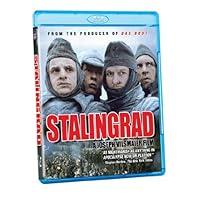
 Before there was "Saving Private Ryan", the most graphic and visceral cinematic battlefield carnage was depicted in "Stalingrad". Ironically, the raw realism which drew rave reviews for SPR had elicited little more than horror and negativity for "Stalingrad". I'm not a sadistic guts'n'gore affictionado, but war is brutal and needs to be presented in an unsanitized manner. "Stalingrad" has been, and remains, my favorite war film. It is from the German producers of "Das Boot", and presents the point of view of the common Wehrmacht soldiers of Paulus' 6th Army, who were abandoned to freeze or be slaughtered in the bombed-out ruins of the city named for Stalin. Neither the Germans nor the Russians are portrayed as heroes or supermen in this film; there is only the desperation of fighters who are forbidden retreat. The anti-Nazi views of the producers are well-known, and occasionally a bit heavy-handed, but there is an admirable attempt to stick to realism. Even the Russians are presented accurately: from the presence of the female corpsman (yes, there were thousands of Russian women combatants at Stalingrad), to the playing of the phonograph song Temnaya Noch', to Stalin's cruel Edict that "there are no POW's -only deserters". The tense ceasefires to allow tending of the wounded are also historically accurate, and are documented in various memoirs. The T-34 tank model depicted is, unfortunately, an anacronism. But the hand-to-hand fighting through the rubble of the buildings, streets, and sewers is realistic. As is the freezing Russian winter which sapped the energy and morale of the stranded Germans reduced to scurrying like rats and eating their own horses. From the cavalier attitudes of the would-be conquerers on the train to the desperation of the hordes of would-be escapees at the airport, this film takes us along with these German soldiers, allowing us to sympathize with their plight and even form a certain detached liking for them. The futility of their campaign haunts the poignant, sorrowful ending of the film (one can't call it a climax), as Russia Herself swallows her violators.
The acting is very good in this film. We aren't meant to be sympathetic to the German soldiers. They are merely cogs in the Nazi war machine. Fallible characters who show both courage and cowardice in the process of the story. I found that it was best to watch the movie in its native German with English subtitles. You get a better feel for the emotional content of the words that are spoken, even if you are not fluent in the language.
The production values are excellent, as are the sets and costumes. This film, to my knowledge, is thoroughly convincing and makes you feel as if you've been drawn into the era to witness the terrible battle as it nears its conclusion. At the end, we see the beginnings of the terrible march to Siberia by German prisoners. Only five percent survived, but I'm sure the Russians would have been satisfied had none of them made the trip.
The only thing I might have wanted to see was a bit more of the perspective of the Russian troops, but I guess that might have made a long film a bit too long.
Truly an unforgiving and brutal anti-war film and not to be missed!That was the question Job once asked himself in the Bible. If Job had been alive and on the eastern front in World War II he may have found the answer to his question Stalingrad. The hellish battle of Stalingrad, as seen through the eyes of a small band of German soldiers, is the subject of director Joseph Vilsmaier's visually stunning and brutal film Stalingrad.
Stalingrad begins on the Italian coast where a German platoon enjoys leave after the Battle of El Alamein in North Africa. Recovering from wounds and enjoying wine and German women while sitting along a bright, sunny, beach the men are called to order. A new opportunity for glory awaits them in Russia. Next stop Stalingrad. We see the platoon boarding a train and entering a tunnel in Italy and exiting a tunnel into Russia. We see the platoon's new officer Lt. Witzland writing home to his wife. A stranger to battle, Witzland writes of the glories to come and of his hopes that he will prove himself to the battle-hardened men under his command. As we shall see, Witzland does indeed prove himself but not in the manner he could ever have predicted.
Witzland's baptism starts immediately upon disembarkation on the outskirts of Stalingrad. Horrified at the mistreatment of some Red Army prisoners he protests only to find himself knocked into the mud and sneered at by the powers that be. Word quickly spreads that this callow youth is a "friend of the Russians" and only his father's military background saves him.
The platoon is ordered to take a factory and the horror begins. Amidst flame throwers, horrible deaths and raw sewage all thoughts of romantic heroism evaporate and Witzland soon learns that survival is the one and only rational, if hopeless, goal one should take into war. Witzland's ultimate humanity never deserts him and, contrary to orders, tries to arrange a brief truce so that the Russians and Germans can gather their wounded. The truce is horribly boggled and the platoon's descent into hell continues in lock step with Stalingrad's descent into a frozen Russian winter. The platoon is arrested for trying to jump the line to get one of their men some medication and they find themselves doing duty as human mine sweepers.
The German army is soon encircled by a Red Army break out and despite the devastation they know is forthcoming the fanatics among them commit even greater horrors. As the men wait for a break through that never comes the excesses of the fanatics continues. The appearance of the men devolves along with the situation. The end, the apocalypse that awaits the trapped Germany army is inevitable; only 6,000 men out of more than 250,000 survived the battle or their imprisonment in the USSR. Witzland's final attempt to reclaim his humanity is a stunning one.
The above outline does not do justice to the power of Stalingrad. Although seen through a German lens that captures no small amount of the humanity of the common German foot soldier, it does not flinch from showing the horrors unleashed in the name of the German people, the Volk, and overseen by a series of true-believers for whom no act of violence is too sadistic or too meaningless. Portraying the differences between the typical German foot soldier and the S.S. for example is not new. However, Vilsmaier handles the distinction in an effective and (seemingly) realistic way that neither excuses the behavior nor tries to limit attribution of horrific acts to a small group of less than human soldiers. Brutality is omnipresent but that brutality renders the flashes of humanity evidenced by the platoon all the more stunning.
Stalingrad is a haunting film and one that will linger long after the final credits run.
Read Best Reviews of Stalingrad Here
When STALINGRAD was released in Germany in 1992 it was accompanied by a flood of books, magazines and modeling kits in honor of the 50th anniversary of the Battle of Stalingrad. As with most German-made World War Two movies, this film focuses on the honorable actions of a small infantry unit rather than the Reich's broader political-stragetic designs. The film opens with a battalion of hardened infantrymen transfering from the relative comfort of Italy to the savage reality of the Steppes. From that point the focus narrows to a handful of German soldiers attempting to survive in world gone mad. Despite the German 6th Army's setback at Stalingrad, the German command continues to believe in its invincibility with resulting detrimental effect on the soldiers.In terms of hardware the film assembled an impressive list of museum pieces including T-34 tanks, Czech-built Hanomag halftracks and a Junkers Ju-52 aircraft for the production. Indeed, the Ju-52 retained its winter camouflage after the filming and made the rounds at air shows.
STALINGRAD does not have much in the way of an impressive soundtrack. Additionally the film drifts from its subject matter to a melancholy ending in the snow. STALINGRAD did not do very well in its limited US big screen release. The widescreen DVD is an improvement over the VHS tape. As other reviewers have recommended, it is best to see the film in German with English subtitles, though the subtitles leave out quite a bit of the dialogue.
Overall this film ranks highly with other war films. A viewer must take into account that this film was originally produced for a European audience. Traditionally foreign war films lack a distinct hero and happy endings are rare.I have read many reviews extremely critical of this movie. Some are warranted, many are not. One complaint is no depiction of Tiger tanks, which is a ludicrous one, considering the tank was not seen on the Eastern Front until the following summer!
Another complaint is about a German 37mm anti-tank gun knocking out Soviet Tanks. Another false one, considering the 37mm had no muzzle brake as depicted in the movie. It looks very much like a Pak36r or Pak40 75mm gun, which was very much capable of taking out Soviet 1942 T-34 Tanks. Be sure of your facts, before complaining. This movie is one of the best for authentic equipment. If you want to see fake, take a closer look at the Tiger tanks in Saving Private Ryan. Their suspension is far from WWII German.
Others complain of the lack of realism in the battle scenes. Who knows of battle realism? It is unfair to compare the effects with movies that were made ten years later. Today's movies simply have a greater technology to work with.
My biggest concern is viewing this movie with an American arrogance and bias. Not all good movies are "Made In America". Sure this movie has it's faults, but don't all? Remember to be fairly honest in a review, we must try to view it for the culture it was intended. Just because you don't "get it" doesn't mean it was cheesy. Watch the movie and make your own judgement. Don't let the ramblings of those here, myself included, make a determination for you. Just have an open mind.
Save 17% Off

No comments:
Post a Comment